
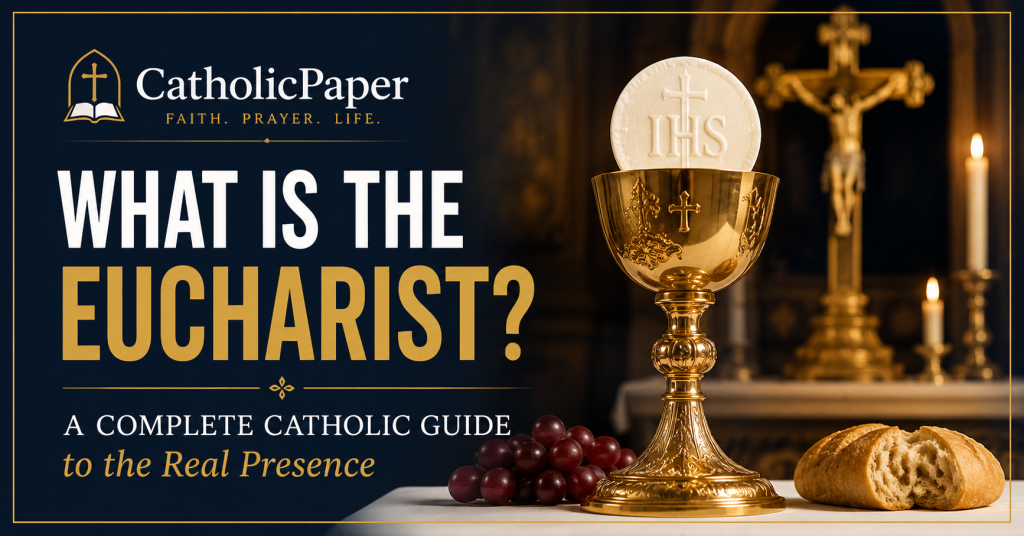
What Is the Eucharist? A Complete Catholic Guide to the Real Presence
At the center of every Catholic Mass is a moment that can appear remarkably simple.
A priest takes bread and wine, repeats the words of Jesus Christ from the Last Supper, and offers them to God. Shortly afterward, Catholics approach the altar to receive what still appears to be bread and wine.
Yet Catholics believe something extraordinary has taken place.
The Church teaches that through the consecration at Mass, the bread and wine truly become the Body and Blood of Jesus Christ. Although their outward appearances remain, their deepest reality has changed. Jesus Christ is truly present—Body, Blood, Soul, and Divinity—in the Eucharist.
This belief is known as the Real Presence of Christ in the Eucharist, and it stands at the heart of Catholic faith and worship.
The Eucharist is not simply a symbol Catholics use to remember Jesus. Nor is Holy Communion merely a reenactment of the Last Supper. Catholics believe that in the Eucharist they encounter the risen Christ Himself and participate sacramentally in the sacrifice He offered on the Cross.
This teaching can be difficult to understand, especially for someone encountering Catholicism for the first time. Even lifelong Catholics can struggle to explain what the Church actually believes about the Eucharist.
What does “Real Presence” mean? What is transubstantiation? Why does the priest consecrate bread and wine? Is the Mass sacrificing Jesus again? Why do Catholics genuflect before the tabernacle? And why is receiving Holy Communion treated so seriously?
To understand Catholicism, these questions matter.
This guide explores what the Eucharist is, where Catholic Eucharistic belief appears in Scripture, how the earliest Christians understood the Eucharist, what happens during Mass, what transubstantiation means, and why Catholics describe the Eucharist as the source and summit of the Christian life.
What Is the Eucharist?
The Eucharist is the sacrament in which Catholics believe Jesus Christ becomes truly present under the appearances of bread and wine. Through the consecration at Mass, the bread and wine become Christ’s Body and Blood while retaining their outward appearances. The Catholic Church calls this change transubstantiation and teaches that Christ is present Body, Blood, Soul, and Divinity.
The word Eucharist comes from a Greek word meaning thanksgiving. The name reflects the thanksgiving offered to God through Christ and recalls Jesus giving thanks at the Last Supper.
Catholics use several terms when speaking about this sacrament.
You may hear:
- The Eucharist
- Holy Eucharist
- Holy Communion
- The Blessed Sacrament
- The Lord’s Supper
- The Breaking of Bread
- The Holy Sacrifice of the Mass
These expressions emphasize different aspects of the same mystery.
“Holy Communion,” for example, emphasizes union with Christ and with His Church.
“The Lord’s Supper” recalls the Last Supper.
“The Breaking of Bread” reflects language found in the New Testament and among the earliest Christians.
“The Blessed Sacrament” emphasizes Christ’s sacramental presence.
And the “Holy Sacrifice of the Mass” emphasizes the Eucharist’s relationship with Christ’s sacrifice on Calvary.
At its heart, however, the Catholic teaching is straightforward:
Jesus Christ is truly present in the Eucharist.
The Eucharist therefore occupies a unique place among Catholic sacraments and devotions. Catholics do not merely encounter something that reminds them of Christ. They believe they encounter Christ Himself.
Why Is the Eucharist So Important to Catholics?
The Church describes the Eucharist as the “source and summit of the Christian life.”
That phrase captures the extraordinary place the Eucharist occupies within Catholicism.
The Eucharist is a source because the Christian life flows from communion with Christ.
It is a summit because Catholic worship reaches its highest expression in the Eucharistic celebration.
Baptism brings a person into the Christian life. Confirmation strengthens the baptized through the Holy Spirit. Reconciliation restores communion when serious sin has damaged it.
But in the Eucharist, Catholics receive Christ sacramentally.
This is why Catholic churches are built around an altar.
It is why the celebration of Sunday Mass is central to Catholic life.
It is why Catholics traditionally show reverence toward the tabernacle.
It is why Eucharistic Adoration exists.
And it is why preparation for First Holy Communion is such an important moment in the lives of Catholic children and converts.
Everything points toward communion with Christ.
The Eucharist in the Bible
Catholic belief in the Eucharist did not begin centuries after Jesus.
Its foundations appear throughout the New Testament and are foreshadowed in the Old Testament.
Several passages are especially important.
Jesus and the Bread of Life — John 6
One of the most important biblical passages for understanding Catholic Eucharistic belief is the sixth chapter of the Gospel of John.
The chapter begins with Jesus miraculously feeding a large crowd with a small amount of bread and fish.
Afterward, Jesus begins teaching about a different kind of bread.
He identifies Himself as the Bread of Life and contrasts the bread He gives with the manna that sustained Israel in the wilderness.
His teaching becomes increasingly striking.
Jesus speaks about giving His flesh for the life of the world and connects eating His flesh and drinking His blood with eternal life.
Many of His listeners find the teaching difficult.
Some leave.
Significantly, Jesus does not respond by explaining that He was merely speaking symbolically in a way they had misunderstood. Instead, the discourse continues.
Catholics have long understood John 6 as an important biblical foundation for belief in Christ’s Real Presence in the Eucharist.
The passage also connects the Eucharist to several themes running throughout Scripture:
bread from heaven, divine nourishment, sacrifice, covenant, and eternal life.
Suggested Scripture: John 6:22–71
If you are new to exploring passages like John 6 in their wider biblical context, our guide to reading the Bible as a Catholic offers a helpful place to begin.
The Last Supper and the Institution of the Eucharist
The clearest foundation for the Eucharist appears at the Last Supper.
On the night before His crucifixion, Jesus gathered with His disciples for a final meal.
During the meal, He took bread, blessed it, broke it, and gave it to His disciples.
He identified the bread with His Body.
He then took the cup and identified it with His Blood, connecting it with the covenant and the forgiveness of sins.
Jesus also commanded His disciples to continue this action in remembrance of Him.
The Church understands this moment as the institution of the Eucharist.
The Last Supper therefore cannot be separated from what occurs the following day on Calvary.
The Body given at the table is the Body offered on the Cross.
The Blood presented in the cup is the Blood poured out in Christ’s Passion.
This connection between the Last Supper and Calvary is essential to understanding the Catholic Mass.
Suggested Scripture: Matthew 26:26–29; Mark 14:22–25; Luke 22:14–20.
St. Paul and the Eucharist
St. Paul’s First Letter to the Corinthians provides some of the earliest written evidence of Christian Eucharistic belief.
Writing only a few decades after the death and Resurrection of Jesus, Paul recounts the tradition of the Last Supper that he himself had received.
He also warns Christians against receiving the Eucharist unworthily.
His language is remarkably serious.
Paul teaches that those who receive without properly discerning the Body bring judgment upon themselves.
That warning would be difficult to explain if the earliest Christians regarded Communion as nothing more than ordinary bread used as a symbolic reminder.
Paul’s teaching demonstrates that profound reverence toward the Eucharist existed extremely early in Christianity.
Suggested Scripture: 1 Corinthians 10:16–17 and 1 Corinthians 11:23–29.
The Road to Emmaus and the Breaking of Bread
Another beautiful Eucharistic passage appears in Luke 24.
After the Resurrection, two disciples encounter Jesus while traveling toward Emmaus, but initially they do not recognize Him.
Jesus walks with them and explains the Scriptures.
Later, at the table, He takes bread, blesses it, breaks it, and gives it to them.
Their eyes are opened.
They recognize Him.
The story brings together two elements Catholics encounter at every Mass:
the Scriptures and the breaking of bread.
At Mass, Catholics first hear God’s Word proclaimed during the Liturgy of the Word and then participate in the Liturgy of the Eucharist.
The Road to Emmaus therefore offers a beautiful biblical image of encountering the risen Christ through Scripture and the breaking of bread.
Catholics who want to spend more time prayerfully reflecting on passages like the Road to Emmaus can also explore Lectio Divina, the ancient practice of praying with Scripture.
Old Testament Foreshadowing of the Eucharist
Catholics also see several Old Testament events as preparing for the Eucharist.
One of the most important is the Passover.
Before Israel’s escape from slavery in Egypt, families sacrificed a lamb and shared a sacred meal. The blood of the lamb marked God’s people for deliverance.
The New Testament identifies Christ with the Passover mystery. Jesus’ death occurs within this biblical world of sacrifice, covenant, and deliverance.
Catholic theology therefore recognizes Christ as the true Paschal Lamb whose sacrifice brings liberation from sin and death.
Another important image is manna in the wilderness.
After Israel’s escape from Egypt, God provided bread from heaven to sustain His people during their journey.
Jesus draws upon this imagery directly in John 6 when describing Himself as the true Bread from heaven.
Catholic tradition also sees Eucharistic foreshadowing in the mysterious figure of Melchizedek, the priest-king who offers bread and wine in Genesis.
These connections reveal that the Eucharist is not an isolated New Testament idea.
It stands within the larger biblical story of covenant, sacrifice, nourishment, deliverance, and communion with God.
What Does “Real Presence” Mean?
The phrase Real Presence refers to the Catholic belief that Jesus Christ is truly and substantially present in the Eucharist. The U.S. Conference of Catholic Bishops provides a detailed explanation of the Real Presence of Jesus Christ in the Eucharist and answers many common questions about this central Catholic belief.
This requires an important clarification.
Catholics do not believe Jesus is merely spiritually present in the way God is present whenever Christians gather in prayer.
Nor do Catholics believe the Eucharist simply represents Christ.
The Church teaches something much stronger.
After consecration, Christ is present Body, Blood, Soul, and Divinity.
The whole Christ is present.
This also means Catholics do not believe that the host contains only Christ’s Body while the chalice contains only His Blood. Christ is wholly present under either Eucharistic species.
This explains why receiving Holy Communion under the appearance of bread alone does not mean someone receives “less” of Christ.
The communicant receives the whole Christ.
The doctrine of the Real Presence is therefore at the heart of Catholic Eucharistic faith.
Watch: Understanding the Real Presence of Jesus in the Eucharist
For a deeper exploration of this central Catholic belief, Bishop Robert Barron explains the Real Presence of Jesus in the Eucharist and why the Eucharist stands at the heart of Catholic faith and worship. His reflection provides additional context for understanding why Catholics believe the Eucharist is far more than a symbol.
What Is Transubstantiation?
One of the most misunderstood Catholic terms associated with the Eucharist is transubstantiation.
The word sounds complicated, but the concept can be explained fairly simply.
Catholic theology distinguishes between the underlying reality—or substance—of something and its observable characteristics.
At Mass, the bread and wine retain their physical appearances.
They still look like bread and wine.
They taste like bread and wine.
Their measurable physical characteristics remain.
But Catholics believe that through the consecration, their deepest reality changes.
The substance of bread becomes the Body of Christ.
The substance of wine becomes the Blood of Christ.
The Church uses the term transubstantiation to describe this change. The Catechism of the Catholic Church’s explanation of transubstantiation teaches that the whole substance of bread and wine is changed into Christ’s Body and Blood, while the outward characteristics remain.
It does not mean that Catholics believe the Eucharist visually transforms into human flesh and blood during every Mass.
The appearances remain those of bread and wine.
What changes is their underlying reality.
This distinction allows the Church to affirm both what human senses observe and what faith recognizes through Christ’s words.
The doctrine attempts to articulate the mystery rather than explain it away.
When Does the Bread and Wine Become the Eucharist?
During the Eucharistic Prayer at Mass, the priest invokes the Holy Spirit and repeats Christ’s words from the Last Supper over the bread and wine.
This central moment is known as the consecration.
The Church teaches that through the action of Christ and the power of the Holy Spirit, the bread and wine become Christ’s Body and Blood.
This is why the congregation ordinarily kneels during this portion of the Mass.
The bells sometimes rung during the consecration developed as a way of drawing attention to these sacred moments.
After the consecration, the priest elevates the host and then the chalice.
Catholics may silently pray or simply adore Christ present before them.
Understanding what the Church believes is happening here can profoundly change how someone experiences Mass.
What appears outwardly simple is, in Catholic belief, an encounter with the mystery of Christ’s sacramental presence.
Is the Mass Sacrificing Jesus Again?
This is one of the most common misunderstandings of Catholic teaching.
The answer is no.
Catholics do not believe Jesus is crucified again at every Mass.
Christ’s sacrifice on Calvary occurred once and for all.
The Letter to the Hebrews strongly emphasizes the unique and definitive character of Christ’s sacrifice.
Catholic teaching agrees.
The Mass does not create another sacrifice alongside Calvary.
Instead, the Church teaches that the one sacrifice of Christ is made sacramentally present.
This is an important distinction.
At Mass, Catholics are not spectators reenacting a historical event as if staging a play.
Through the Eucharistic celebration, the Church participates sacramentally in Christ’s one eternal offering to the Father.
The sacrifice of the Mass and the sacrifice of Calvary are therefore not two different sacrifices.
They are the same sacrifice made present sacramentally, though the manner of offering differs. Vatican II’s Constitution on the Sacred Liturgy, Sacrosanctum Concilium, provides a broader explanation of the Eucharistic sacrifice, Christ’s presence in the liturgy, and the place of the Eucharist within Catholic worship.
This is why Catholics call the Mass a sacrifice without believing that Christ dies repeatedly.
The Eucharist as Communion
The word Communion points toward another essential dimension of the Eucharist: unity.
Receiving the Eucharist expresses communion with Christ.
But it also expresses communion with His Church.
St. Paul uses the image of many people sharing one bread and therefore becoming one body.
The Eucharist is consequently both personal and communal.
A Catholic approaches the altar individually and receives Christ personally.
Yet the sacrament simultaneously unites the faithful with the wider Body of Christ.
This helps explain why the Catholic Church treats Eucharistic Communion differently from an ordinary gesture of hospitality.
Receiving Communion is not simply saying, “I believe in Jesus.”
It expresses a deeper sacramental unity with Christ and His Church.
This is also why questions about who should receive Communion are connected to Catholic teaching about faith, baptism, Church communion, and spiritual preparation.
Why Do Catholics Genuflect?
If you enter a Catholic church, you may notice people briefly kneeling on one knee before entering a pew.
This gesture is called a genuflection.
Catholics genuflect toward the tabernacle when the Blessed Sacrament is reserved there because they believe Christ is truly present.
The gesture is an act of reverence and worship.
This is also why Catholic churches often maintain a lamp near the tabernacle indicating the presence of the Blessed Sacrament.
The physical gestures of Catholic worship—kneeling, bowing, genuflecting, and making the Sign of the Cross—express spiritual realities through the body.
Catholic worship recognizes that human beings are not disembodied minds.
We worship God with our whole selves.
What Is the Tabernacle?
The tabernacle is the secure place in a Catholic church where consecrated hosts are reserved.
The Eucharist is reserved principally so Holy Communion can be brought to those who are sick or unable to attend Mass.
Because Catholics believe Christ remains truly present in the consecrated Eucharist, the tabernacle also becomes a natural focus for prayer and reverence.
Catholics may visit a church outside Mass simply to pray before Christ present in the tabernacle.
This practice eventually contributed to the development of more formal Eucharistic devotions such as exposition and Adoration.
What Is Eucharistic Adoration?
Eucharistic Adoration is prayer before Christ present in the Blessed Sacrament.
During formal exposition, a consecrated host is ordinarily displayed in a vessel called a monstrance.
Catholics may spend time reading Scripture, praying, meditating, or simply sitting silently before Christ.
Adoration flows directly from belief in the Real Presence.
If the Eucharist were merely symbolic, worship directed toward it would make little sense.
But if Christ is truly present, then spending time in prayer before the Blessed Sacrament becomes an encounter with Him.
For a complete explanation of what happens during Adoration and how to make a Holy Hour, see our Beginner’s Guide to Eucharistic Adoration.
How Should Catholics Prepare to Receive Holy Communion?
Because Catholics believe they receive Christ Himself in the Eucharist, preparation for Communion is important.
Preparation begins with recognizing what—or rather Whom—one is about to receive.
Catholics should approach Communion with faith and reverence rather than treating it as an automatic part of attending Mass.
The Church also teaches the importance of being properly disposed spiritually.
Catholics conscious of grave sin ordinarily receive the Sacrament of Reconciliation before receiving Holy Communion.
The Church also maintains a Eucharistic fast before Communion, with exceptions for circumstances such as medicine and certain health needs.
Beyond these requirements, spiritual preparation can be simple.
Before Mass, you might pray:
Jesus, help me receive You with faith, gratitude, and love.
During the Communion procession, try to remain attentive rather than distracted.
After receiving, use the period of silence for thanksgiving.
These small habits can help prevent something extraordinary from becoming routine.
What Should Catholics Do After Receiving Communion?
The minutes immediately following Holy Communion provide a special opportunity for prayer.
Rather than immediately thinking about leaving church or what comes next in the day, Catholics can use this time to offer thanksgiving.
You might thank Christ for His presence.
Bring Him your intentions.
Pray for your family.
Ask for the grace to become more like Him.
Or simply remain quiet.
Formal prayers can be helpful, but elaborate words are unnecessary.
Familiar prayers such as the Our Father can also provide a simple way to remain focused on God during times of prayer and thanksgiving.
A simple prayer such as:
“Jesus, thank You for coming to me. Help me remain close to You.”
can be enough.
Eucharistic spirituality does not end when Mass concludes.
Receiving Christ should gradually transform how Christians live once they leave the church.
The Eucharist and Christian Life
The Eucharist is not meant to remain disconnected from ordinary life.
If Catholics receive Christ in the Eucharist, that encounter should influence how they treat other people.
It should deepen charity.
Strengthen forgiveness.
Increase concern for those who suffer.
Encourage humility.
And create a greater desire to live according to the Gospel.
The Eucharist therefore has profound implications for Catholic moral and social life.
Christ gives Himself completely.
Christians who receive Him are called to become increasingly self-giving themselves.
The movement of the Mass is ultimately outward.
Catholics gather.
They hear God’s Word.
They receive Christ.
And then they are sent back into the world.
The Eucharist and Prayer
The Eucharist can also transform personal prayer.
Someone who develops deeper Eucharistic faith may begin approaching Scripture differently.
Practices such as Lectio Divina can provide a prayerful way to return to passages such as John 6, the Last Supper, and the Road to Emmaus and contemplate them more deeply. Then, participation in Sunday Mass may begin to feel less like an obligation and more like the center around which the rest of the week is organized.
For those looking to carry that relationship with Christ into the rest of the week, developing a daily Catholic prayer routine can help make prayer a consistent part of everyday life.
Eucharistic Miracles and Catholic Faith
Throughout Christian history, Catholics have reported events commonly described as Eucharistic miracles.
Some involve unusual changes associated with consecrated hosts or other extraordinary circumstances.
These stories have inspired devotion and investigation, and some have received varying degrees of ecclesiastical recognition.
However, an important distinction should be made.
Catholic belief in the Eucharist does not depend upon Eucharistic miracles.
The foundation of Eucharistic faith is Christ’s teaching, Scripture, Apostolic Tradition, and the Church’s sacramental faith.
Extraordinary events may encourage devotion, but Catholics are not required to base belief in the Real Presence upon them.
The ordinary Eucharistic miracle, so to speak, is what Catholics believe occurs quietly at every Mass: Christ gives Himself to His people under the appearances of bread and wine.
The Eucharist in the Early Church
One of the strongest indications that Eucharistic belief did not emerge late in Christian history comes from the writings of early Christians.
Writers from the first centuries describe Eucharistic worship in ways strikingly familiar to Catholics today.
St. Ignatius of Antioch, writing near the beginning of the second century, speaks about the Eucharist in explicitly realistic terms and criticizes those who reject its connection with the flesh of Christ.
St. Justin Martyr, writing in the second century, provides a description of Christian worship that includes readings, prayers, bread and wine, thanksgiving, and distribution of the Eucharist.
His account contains recognizable similarities to the basic structure of the Catholic Mass.
These writings matter because they come from Christians living remarkably close to the apostolic age.
They show that Eucharistic worship, reverence, and belief were deeply embedded in Christianity long before medieval theological terminology such as “transubstantiation” developed.
The terminology became more precise over time.
The underlying Eucharistic faith was much older.
Frequently Asked Questions About the Eucharist
Is the Eucharist Just a Symbol?
Catholic teaching says no. While the Eucharist certainly has symbolic dimensions, Catholics believe Christ is truly and substantially present.
Does the Bread Physically Look Different After Consecration?
Ordinarily, no. The appearances and physical properties of bread and wine remain. The Church describes the change in their underlying substance as transubstantiation.
Is Jesus Present in Every Piece of the Consecrated Host?
Catholic teaching holds that Christ is wholly present under each Eucharistic species and in each part after separation.
Do Catholics Worship Bread?
No. Catholics worship Christ whom they believe is truly present under the appearances of bread and wine.
Why Can’t Everyone Automatically Receive Catholic Communion?
Receiving the Eucharist expresses both communion with Christ and unity with the Catholic Church’s faith and sacramental life. For that reason, the Church has norms governing reception of Holy Communion.
Does Mass Sacrifice Jesus Again?
No. Catholics believe Christ’s sacrifice occurred once for all. The Mass makes that one sacrifice sacramentally present rather than repeating the Crucifixion.
What Is the Difference Between Eucharist and Communion?
The terms are closely related. “Eucharist” often refers broadly to the sacrament and Eucharistic celebration, while “Holy Communion” particularly emphasizes receiving Christ and the communion created through the sacrament.
Why Does the Priest Elevate the Host?
The elevation directs the faithful’s attention toward Christ present in the consecrated Eucharist and provides a moment for adoration.
How to Deepen Your Understanding of the Eucharist
The Eucharist is a mystery Catholics can spend an entire lifetime contemplating.
If you want to understand it more deeply, begin with Scripture. If reading the Bible feels intimidating or you aren’t sure where to start, our Catholic beginner’s guide to reading the Bible can help you develop a practical approach to Sacred Scripture.
Read John 6 slowly.
Read the Last Supper accounts.
Read St. Paul’s teaching in First Corinthians.
Read the Road to Emmaus.
Then pay closer attention at Mass.
Listen carefully to the Eucharistic Prayer.
Notice how frequently the language refers to sacrifice, covenant, thanksgiving, Christ’s death and Resurrection, the Holy Spirit, and the unity of the Church.
Consider arriving at Mass several minutes early so you can become quiet.
Stay for a few minutes afterward and offer thanksgiving.
And if your parish offers Eucharistic Adoration, consider spending some time before the Blessed Sacrament outside Mass.
Catholic Eucharistic faith is ultimately not intended to remain an intellectual concept.
It is meant to lead toward encounter.
Readers who want to continue exploring Catholic teaching and spirituality surrounding the Eucharist may also find helpful books and resources on the Eucharist from Paulist Press’ Book by Ansgar Wucherpfennig, SJ called How Did Jesus Want the Eucharist? : Looking Back to Find a Way Forward
Conclusion: The Heart of Catholic Life
To understand why the Eucharist matters so deeply to Catholics, return to the simplest claim at the heart of everything discussed in this guide:
Catholics believe the Eucharist is Jesus Christ.
Under the appearances of bread and wine, the Church believes the risen Christ gives Himself completely—Body, Blood, Soul, and Divinity.
This belief explains the reverence surrounding Holy Communion.
It explains the tabernacle.
It explains genuflection.
It explains Eucharistic Adoration.
It explains why Catholics have celebrated the breaking of bread since the earliest days of Christianity.
And it explains why the Church calls the Eucharist the source and summit of Christian life.
The Eucharist connects the Last Supper with Calvary, the Resurrection with the life of the Church, and Christ’s sacrifice with the believer standing at Mass today.
As you continue growing in Eucharistic faith, you can also explore our Catholic Prayers collection for traditional prayers and resources to support your daily spiritual life.
For someone beginning to explore Catholicism, the doctrine can initially seem difficult.
For someone who has been Catholic for decades, familiarity can sometimes make the mystery easy to overlook.
Both are invited to look again.
Read the Scriptures.
Listen closely at Mass.
Spend time before the Blessed Sacrament.
And consider what the Church is actually claiming when the priest holds the consecrated host before the congregation:
Christ has not abandoned His people.
He remains with His Church.
And in the Eucharist, Catholics believe He continues to give Himself to them.
Pingback: What Happens at Catholic Mass? A Complete Step-by-Step Guide for Beginners - Catholic Paper