Eucharistic Adoration Explained: A Catholic Beginner’s Guide to Praying Before the Blessed Sacrament in 60 Minutes
For someone walking into Eucharistic Adoration for the first time, the experience can be strikingly simple.
There may be no music. No homily. No conversation. Depending on the parish, there may only be a handful of people scattered throughout the church or chapel, kneeling or sitting silently before the altar.
At the center is the Eucharist.
For Catholics, however, this silence is far from empty. Eucharistic Adoration is an opportunity to spend time in prayer before Jesus Christ, whom Catholics believe is truly present in the Blessed Sacrament.
Adoration has therefore become one of the Church’s most treasured forms of prayer. Some Catholics spend an entire Holy Hour before the Eucharist. Others stop into a church for only a few minutes. Some pray the Rosary, others read Scripture, and still others simply sit quietly in the presence of Christ.
If you have never attended Eucharistic Adoration, you may have questions. What exactly are you supposed to do? Do you need to pray certain prayers? Why is the Eucharist displayed on the altar? What is a monstrance? Can you simply sit there quietly?
The answer to that last question is yes.
There is no single formula you must follow to experience Adoration fruitfully. The purpose is ultimately very simple: to be with Christ.
This guide explains what Eucharistic Adoration is, why Catholics practice it, what to expect when you attend, and several ways you can use your time before the Blessed Sacrament to deepen your relationship with God.
What Is Eucharistic Adoration?
Eucharistic Adoration is a Catholic devotion in which the faithful pray in the presence of the Blessed Sacrament.
Catholics believe that during the celebration of the Eucharist at Mass, bread and wine become the Body and Blood of Jesus Christ while retaining their outward appearances. The consecrated Eucharist is therefore treated with profound reverence because Catholics believe Christ Himself is truly present.
Adoration extends this Eucharistic worship beyond the celebration of Mass.
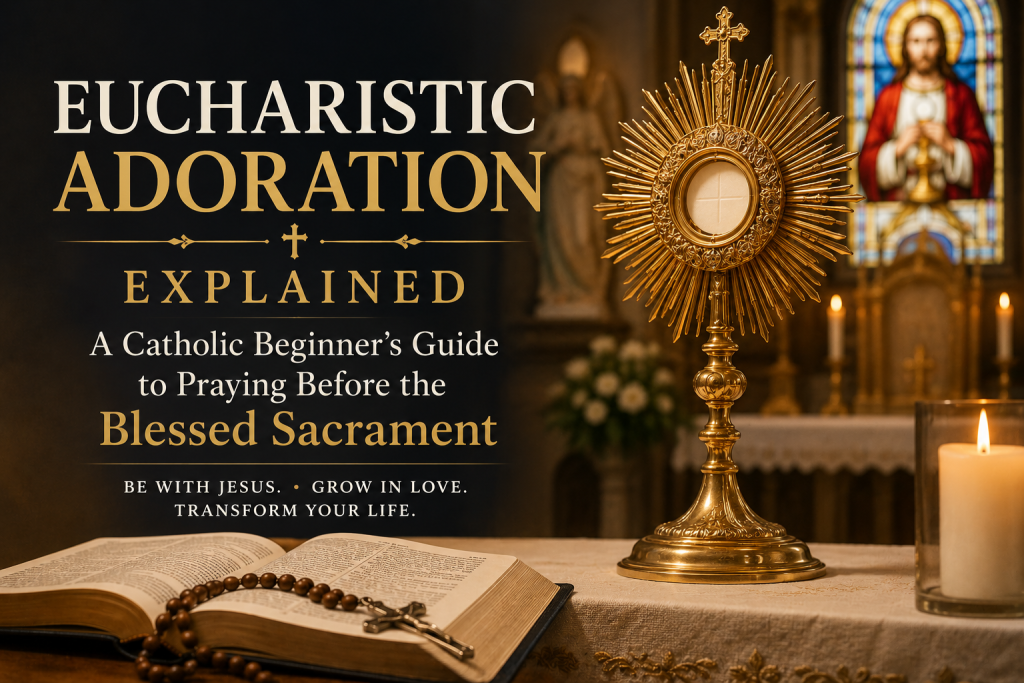
During Eucharistic exposition, a consecrated host is ordinarily placed inside a vessel called a monstrance and displayed on the altar so that the faithful can pray before the Blessed Sacrament.
The monstrance is often designed with rays extending outward from its center, visually drawing attention toward the Eucharist.
Adoration may last for an hour, several hours, or even continuously at parishes that offer perpetual Adoration.
Other churches may offer a weekly or monthly Holy Hour.
Catholics may also pray before Christ in the Eucharist when the Blessed Sacrament remains reserved inside the tabernacle, even when there is no formal exposition.
The central idea remains the same: spending time intentionally in the presence of Christ.
For Catholics accustomed to prayers involving words, Adoration can initially feel unusual. There may be long stretches of silence. Nothing appears to be happening.
But that silence is part of its beauty.
Adoration invites the believer to stop doing and simply be with God.
Why Do Catholics Adore the Eucharist?
To understand Eucharistic Adoration, it is necessary to understand Catholic belief about the Eucharist.
Catholics do not believe the Eucharist is merely a symbol reminding Christians of Jesus.
The Church teaches that Christ is truly present—Body, Blood, Soul, and Divinity—in the Eucharist.
At the Last Supper, Jesus took bread and wine and identified them with His Body and Blood. The Church has understood the Eucharist as central to Christian worship from its earliest centuries.
Because Catholics believe Christ is truly present in the Blessed Sacrament, worship directed toward the Eucharist is ultimately worship directed toward Jesus Himself.
This is why Catholics genuflect toward the tabernacle, receive Holy Communion with reverence, and spend time praying before the Eucharist.
Eucharistic Adoration therefore flows directly from the celebration of the Mass.
The Mass remains the center of Catholic Eucharistic life. Adoration does not replace it. Rather, Adoration can deepen a person’s appreciation for what occurs during Mass.
The more time someone spends contemplating Christ’s presence in the Eucharist, the easier it can become to approach Holy Communion with greater reverence and gratitude.
The Catechism of the Catholic Church’s teaching on the Real Presence and Eucharistic Adoration explains this belief in greater detail.
The Biblical Foundation of Eucharistic Adoration
Although the formal practices surrounding Eucharistic Adoration developed over centuries, Eucharistic devotion is rooted in Scripture and particularly in Christ’s words concerning the Bread of Life and the Last Supper.
One of the most important passages appears in John 6.
After feeding the multitude, Jesus speaks extensively about the bread that comes down from heaven and identifies Himself as the Bread of Life.
The chapter has held enormous importance in Catholic reflection on the Eucharist.
Later, during the Last Supper, Jesus takes bread, gives thanks, breaks it, and gives it to His disciples. The accounts of the Last Supper became foundational to the Church’s celebration of the Eucharist.
St. Paul also discusses the Eucharist in his First Letter to the Corinthians, demonstrating that Eucharistic worship was already central to Christian communities in the earliest decades of the Church.
For Catholics, these passages help reveal why the Eucharist occupies such an extraordinary place in Christian life.
The Eucharist is connected not merely to remembering Jesus but to encountering Him.
That belief provides the foundation for Eucharistic Adoration.
Suggested Scripture passages to read: John 6:22–59; Matthew 26:26–29; Luke 22:14–20; 1 Corinthians 11:23–29.
To learn more about how to read the bible check out the following article: How to Read the Bible as a Catholic
A Brief History of Eucharistic Adoration
Christians have shown profound reverence toward the Eucharist since the earliest centuries of the Church.
The reservation of the Eucharist originally developed primarily so that Holy Communion could be brought to Christians who were sick or unable to attend the liturgy. Over time, devotion to Christ’s Eucharistic presence outside Mass continued to develop.
During the Middle Ages, Eucharistic devotion expanded considerably in Western Christianity.
The establishment of the feast of Corpus Christi, celebrating the Body and Blood of Christ, played an especially important role in encouraging Eucharistic devotion.
Practices such as Eucharistic processions, exposition of the Blessed Sacrament, and periods of prolonged Adoration became increasingly widespread.
The Church continued encouraging Eucharistic devotion in subsequent centuries, while always emphasizing its connection with the Mass.
Today, Adoration takes many forms.
Some parishes offer a weekly Holy Hour. Others hold Adoration on particular feast days or First Fridays. Some Catholic communities maintain chapels where Eucharistic Adoration continues throughout much of the day.
A smaller number maintain perpetual Adoration, where people take scheduled periods so that someone remains in prayer before the Blessed Sacrament day and night.
Despite differences in form, the purpose remains unchanged: worship of Christ and deeper communion with Him.
What Happens During Eucharistic Adoration?
If you have never attended Adoration, you do not need to be nervous.
The atmosphere is generally quiet and prayerful.
During formal exposition, the priest or deacon places the Blessed Sacrament in the monstrance on the altar. Depending on the service, there may be hymns, incense, Scripture, or periods of communal prayer.
At other times, particularly during extended periods of Adoration, people simply enter and leave quietly throughout the day.
You may see people:
- kneeling in prayer,
- sitting silently,
- reading Scripture,
- praying the Rosary,
- writing in a spiritual journal,
- reading a devotional book,
- or simply looking toward the Eucharist.
There is no requirement that everyone pray in exactly the same way.
When entering a church where the Blessed Sacrament is exposed, Catholics traditionally show particular reverence before taking their place. Local customs can vary, so observing the practices of the parish can be helpful.
Once seated or kneeling, you are free to pray.
And if you don’t know what to say, that is perfectly fine.
Silence itself can become prayer.
What Should You Do During Eucharistic Adoration?
One of the most common questions beginners ask is: What am I supposed to do for an entire hour?
First, you do not have to stay for an hour.
The term Holy Hour is often associated with Eucharistic Adoration, but spending 10, 20, or 30 minutes before the Blessed Sacrament can also be meaningful.
If you do spend an hour, you also do not need to fill every minute with words.
Here are several approaches.
Begin by Simply Becoming Quiet
Before immediately opening a prayer book or beginning the Rosary, spend a few moments becoming aware of where you are.
Put away your phone.
Slow your breathing.
Look toward the Eucharist.
Remind yourself that you have intentionally set aside this time for God.
You might begin simply:
“Jesus, I am here.”
Sometimes that is enough.
Watch: What Is Eucharistic Adoration?
For another introduction to Eucharistic Adoration, Bishop Robert Barron explains why spending time before the Blessed Sacrament has occupied such an important place in Catholic spiritual life. Watch the short reflection below, then continue through our guide for practical ways to begin your own time in Adoration.
Speak to Jesus in Your Own Words
Prayer does not always require formal language.
Tell Christ what is happening in your life.
You might speak about:
- something worrying you,
- a decision you need to make,
- someone you love,
- something for which you are grateful,
- a temptation you are struggling with,
- or a hope you carry.
Prayer can be remarkably simple.
The Psalms demonstrate this beautifully. They contain praise, gratitude, fear, anger, confusion, repentance, and hope.
God already knows what is in your heart. Personal prayer is an opportunity to bring those realities consciously into your relationship with Him.
Pray with Scripture During Adoration
Adoration is an excellent setting for reading Sacred Scripture.
Rather than attempting to read several chapters, choose a short passage and read it slowly.
The Gospels are particularly appropriate because they allow you to spend time contemplating the words and actions of Christ while praying before the Eucharist.
You might read about:
- the Last Supper,
- the Bread of Life discourse,
- the Good Shepherd,
- Christ’s Passion,
- the Resurrection,
- or one of Jesus’ encounters with an individual seeking healing or forgiveness.
Read slowly.
Pause.
Allow a particular phrase to remain with you.
You don’t need to finish a chapter.
Sometimes a single sentence can become the focus of an entire period of prayer.
Practice Lectio Divina During Adoration
If you already practice Lectio Divina, Eucharistic Adoration provides a beautiful environment for it.
Choose a short Scripture passage and move through the traditional four stages:
Lectio — Read
Read the passage carefully.
Meditatio — Meditate
Consider what stands out and what God may be revealing through the text.
Oratio — Pray
Respond to God with your own prayer.
Contemplatio — Contemplate
Become quiet and rest in God’s presence.
The final stage fits especially naturally with Eucharistic Adoration.
You have read God’s Word.
You have reflected.
You have spoken.
Now you can simply remain with Christ.
Praying the Rosary During Eucharistic Adoration
The Rosary is a deeply Christ-centered devotion that can help Catholics meditate on the life, ministry, Passion, death, and Resurrection of Jesus. When prayed during a personal visit before the Blessed Sacrament, the Rosary can help direct the heart toward Christ through contemplation of the Gospel mysteries.
The Joyful Mysteries invite us to reflect on the Incarnation and early life of Jesus. The Luminous Mysteries lead us through important moments in His public ministry, including the Institution of the Eucharist. The Sorrowful Mysteries draw our attention to Christ’s Passion and sacrifice, while the Glorious Mysteries proclaim His Resurrection, Ascension, and victory over death.
During Eucharistic Adoration, however, the central focus should always remain on Jesus Christ present in the Blessed Sacrament. The U.S. Conference of Catholic Bishops emphasizes that periods of Eucharistic exposition should include prayer, Scripture, song when appropriate, and sufficient periods of sacred silence so that the faithful can deepen their relationship with Christ.
If you choose to pray the Rosary during a personal period of Adoration, consider allowing its mysteries to lead you more deeply toward Christ rather than simply reciting the prayers quickly. You might pray a single decade slowly, contemplate the corresponding Gospel scene, and then spend several minutes in silence before the Eucharist.
For example, the Fifth Luminous Mystery—the Institution of the Eucharist—is particularly fitting for Eucharistic Adoration. As you meditate on the Last Supper, you can reflect on Christ’s gift of Himself in the Eucharist while praying before the Blessed Sacrament.
The Rosary can therefore complement Eucharistic prayer when it leads the believer toward deeper contemplation of Christ. At formal periods of exposition, communal devotions should also follow the liturgical norms and practices of the parish.
Use Traditional Catholic Prayers
You can also bring familiar Catholic prayers into your time of Adoration.
The Our Father is particularly fitting because it was given to the disciples by Christ Himself.
You might also pray:
- the Glory Be,
- acts of faith, hope, and charity,
- prayers of thanksgiving,
- prayers of repentance,
- or prayers specifically written for Eucharistic devotion.
Traditional prayers can be especially helpful when your mind feels distracted or you do not know what to say.
But they do not need to fill the entire period.
Allow silence between prayers.
Sit Silently with Christ
This may eventually become one of the most meaningful parts of Adoration.
You do not always have to read.
You do not always have to speak.
You do not always have to be “doing” something.
Christian prayer ultimately involves relationship, and relationships include moments when words are unnecessary.
Consider two close friends or a married couple who can comfortably sit together without constantly speaking. Their silence does not indicate absence. Their presence communicates something of its own.
Adoration can develop a similar quality.
You are there.
Christ is present.
Sometimes that is enough.
Silence may initially feel uncomfortable because daily life provides so little of it. Resist the urge to immediately reach for your phone or find something else to occupy your attention.
Allow yourself to become still.
A Simple 60-Minute Holy Hour for Beginners
If spending an entire hour in Adoration feels intimidating, a loose structure can help.
You do not need to follow this exactly, but it provides a starting point.
First 5 Minutes: Become Present
Settle into silence and acknowledge God’s presence.
10 Minutes: Thanksgiving
Thank God for blessings in your life, both large and small.
15 Minutes: Scripture
Read a Gospel passage slowly and prayerfully.
10 Minutes: Personal Prayer
Bring your needs, concerns, family, friends, and intentions before Christ.
10 Minutes: Meditative or Traditional Prayer
Continue reflecting on Scripture, pray a traditional Catholic prayer, or use a Christ-centered devotion that helps direct your attention toward Jesus present in the Eucharist
Final 10 Minutes: Silence
Put everything aside.
Simply remain with Christ.
You may eventually discover that you no longer need a schedule. The structure exists to help you begin, not to turn prayer into another checklist.
What If You Get Distracted During Adoration?
You probably will.
Almost everyone does.
You may suddenly remember an email you forgot to send, something you need from the grocery store, an argument from three days ago, or what you’re having for dinner.
Distraction does not mean your prayer has failed.
When you notice that your attention has wandered, gently return it to God.
You can repeat a short prayer such as:
“Jesus, I trust in You.”
Or simply look toward the Eucharist again.
The goal is not perfect concentration. Prayer involves repeatedly choosing to return your attention to God.
Over time, silence often becomes easier.
What If You Don’t Feel Anything?
Another common misconception is that good prayer should always produce a strong emotional experience.
It doesn’t.
There may be days when Adoration brings profound peace.
There may be other days when you feel distracted, restless, tired, or spiritually dry.
The value of prayer does not depend entirely upon emotion.
Relationships are built through faithfulness, not merely through moments of intense feeling.
Showing up to pray even when prayer feels ordinary can itself become an act of love.
Do not measure every Holy Hour by how emotional or spiritually powerful it felt.
Sometimes spiritual growth occurs quietly.
Eucharistic Adoration and Daily Catholic Life
The purpose of Adoration is not to isolate Catholics from ordinary life.
Ideally, it changes how they return to it.
Time spent before Christ should gradually influence how we treat other people, how we respond to difficulties, how we forgive, how we make decisions, and how we recognize Christ in those around us.
Prayer and action belong together.
Adoration can also provide a place to bring the pressures of daily life before God rather than carrying them alone.
Parents can pray for their children.
Students can bring uncertainty about their futures.
Workers can bring difficult decisions.
Those experiencing grief can sit before Christ even when they have no words.
Those experiencing joy can offer thanksgiving.
There is room for the entirety of human life before the Blessed Sacrament.
How Often Should Catholics Go to Adoration?
There is no universal requirement that Catholics attend Eucharistic Adoration a certain number of times each week or month.
Some people attend weekly.
Others attend monthly.
Some stop briefly at a church whenever they have an opportunity.
If you are beginning, consider making Adoration part of your routine once a month.
If you find it fruitful, you might eventually attend weekly.
Consistency can be helpful because regular prayer gradually becomes part of the rhythm of life.
The important thing is not to turn Adoration into a competition or measure your spirituality against someone else’s.
Begin where you are.
Even a short visit can be meaningful.
Eucharistic Adoration and the Mass
It is important to keep Adoration in its proper context.
Eucharistic Adoration does not replace Sunday Mass.
The Mass is the source and summit of Christian life, and Eucharistic Adoration flows from the Eucharistic celebration.
In Adoration, Catholics worship the same Christ whom they receive sacramentally in Holy Communion.
The two practices therefore reinforce one another.
Adoration can increase reverence for the Eucharist at Mass, while participation in Mass gives Eucharistic Adoration its deepest context.
A healthy Eucharistic spirituality always leads back toward the liturgy, the sacraments, and the life of the Church.
The U.S. bishops offer additional resources on Eucharistic devotion and Holy Hours, including an explanation of how Adoration flows from the celebration of the Mass.
What Is Benediction of the Blessed Sacrament?
If you attend a scheduled period of Eucharistic Adoration, it may conclude with Benediction.
Benediction is a liturgical devotion in which a priest or deacon blesses the faithful with the Blessed Sacrament.
The service may include Eucharistic hymns, prayers, incense, and periods of silence.
At the conclusion, the Eucharist is returned to the tabernacle in a process known as reposition.
If you are attending Benediction for the first time, don’t worry about knowing every response or action.
Simply follow the congregation and participate prayerfully.
Over time, the structure will become familiar.
Eucharistic Adoration for Beginners: What Should I Bring?
You technically need to bring nothing.
But several items can be useful:
- a Catholic Bible,
- Rosary beads,
- a prayer book,
- a spiritual journal,
- or devotional reading.
Avoid bringing so much material that you feel pressured to use all of it.
Adoration is not a study session.
Bring whatever helps you pray.
And consider keeping your phone silenced and out of sight unless you genuinely need it for Scripture or a prayer resource.
Reducing distractions can make entering into silence considerably easier.
Frequently Asked Questions About Eucharistic Adoration
Do I Have to Stay for an Entire Hour?
No. You can spend whatever amount of time you are reasonably able to give. Even a short visit can provide an opportunity for meaningful prayer.
Can I Pray the Rosary During Adoration?
Yes. The Rosary is a Christ-centered meditation and can be prayed during Adoration.
Can I Read the Bible During Adoration?
Absolutely. Scripture reading and Lectio Divina are excellent ways to pray before the Blessed Sacrament.
What If I Don’t Know Any Special Eucharistic Prayers?
You don’t need to know any. Speak to Christ in your own words, use prayers you already know, read Scripture, or simply remain silent.
Can Non-Catholics Attend Eucharistic Adoration?
Generally, visitors are welcome to quietly attend Adoration, although local parish practices should always be respected. Someone unfamiliar with Catholic customs can simply sit quietly and observe.
Do I Have to Kneel the Entire Time?
No. Catholics may kneel or sit during extended periods of private Adoration. Physical limitations should always be respected.
Why Is the Eucharist Displayed in a Monstrance?
The monstrance allows the consecrated host to be visibly exposed for the faithful during Eucharistic Adoration.
Is Adoration the Same as Mass?
No. The celebration of Mass and Eucharistic Adoration are distinct, although intimately connected. Adoration flows from Catholic belief in Christ’s Eucharistic presence celebrated at Mass.
How to Begin Eucharistic Adoration
If you have never experienced Eucharistic Adoration, your first visit does not need to be complicated.
Find a nearby Catholic parish that offers Adoration and choose a time when you can spend perhaps 15 or 20 minutes there.
Enter quietly.
Take your place.
Look toward the Eucharist.
Begin with the Sign of the Cross.
You might pray the Our Father.
Read several verses from one of the Gospels.
Tell Christ what is on your mind.
Then spend several minutes in silence.
That’s enough.
You don’t need to have a dramatic spiritual experience.
You don’t need to master a particular prayer method.
You simply need to begin.
As Adoration becomes more familiar, you may find yourself wanting to remain longer. What once seemed like an intimidating hour of silence can gradually become a treasured period of peace.
Making Adoration Part of Your Prayer Life
A healthy Catholic prayer life contains different forms of prayer.
There is vocal prayer, such as the Our Father.
There is meditative prayer, such as the Rosary.
There is prayer with Scripture through practices such as Lectio Divina.
And there is contemplative prayer, where words gradually give way to silence before God.
Eucharistic Adoration can bring all of these together.
You can arrive with Scripture.
You can pray the Rosary.
You can speak personally with Christ.
And eventually you can become silent.
Adoration therefore does not need to replace the other Catholic prayer practices you already love. Instead, it can become a place where those practices come together in the presence of the Eucharist.
Conclusion: An Invitation to Spend Time with Christ
Eucharistic Adoration is ultimately much simpler than it may first appear.
Catholics come before the Blessed Sacrament because they believe they are coming before Jesus Christ.
You do not need eloquent prayers.
You do not need an advanced understanding of theology.
You do not need to know how to spend an entire Holy Hour.
You can begin with a few quiet minutes.
Bring your gratitude, questions, worries, hopes, failures, and joys. Read Scripture. Pray the Rosary. Speak honestly to God. Or simply sit silently before Him.
Over time, those quiet moments can become an important part of a Catholic’s spiritual life.
In a world constantly competing for our attention, Eucharistic Adoration offers something increasingly rare: silence, stillness, and an opportunity to turn our complete attention toward Christ.
If you have never attended Adoration before, consider finding a Catholic parish near you that offers it and making a short visit.
Sit down.
Become still.
And begin with the simplest prayer:
Jesus, I am here.