What Happens at Catholic Mass? A Complete Step-by-Step Guide for Beginners
Walking into a Catholic church for Mass for the first time can feel unfamiliar.
People dip their fingers into holy water. Some make the Sign of the Cross. Others genuflect before entering their pew. There are moments when everyone stands, sits, or kneels. Scripture is proclaimed, prayers are recited together, bells may ring, and eventually much of the congregation approaches the altar to receive Holy Communion.
If you have never attended Catholic Mass—or even if you have attended Mass for years without understanding every part—you may wonder what all of these actions mean.
Why does the priest wear special vestments? Why are there so many Scripture readings? Why do Catholics kneel? What happens to the bread and wine? What is the difference between the Liturgy of the Word and the Liturgy of the Eucharist? And what should someone who is not Catholic do when everyone else receives Communion?
Behind these prayers and gestures is a remarkably rich form of Christian worship.
The Catholic Mass is not simply a weekly prayer service or gathering of believers. Catholics believe that during the Mass they encounter Christ in His Word, worship with the whole Church, participate sacramentally in Christ’s one sacrifice, and receive Jesus Christ Himself in the Eucharist.
The Mass therefore stands at the center of Catholic life.
Whether you’re visiting a Catholic church for the first time, returning after years away, exploring Catholicism, or simply hoping to understand the Mass more deeply, this guide will walk you through what happens at Catholic Mass step by step.
What Is the Catholic Mass?
The Mass is the central act of worship in the Catholic Church.
Every Mass contains two principal parts:
The Liturgy of the Word and the Liturgy of the Eucharist.
These two parts form one act of worship.
During the Liturgy of the Word, Catholics listen to readings from Sacred Scripture and hear the Gospel proclaimed.
During the Liturgy of the Eucharist, bread and wine are brought to the altar, the Eucharistic Prayer is offered, and Catholics believe the bread and wine become the Body and Blood of Jesus Christ.
The congregation then receives Holy Communion.
The structure is deeply connected to Scripture itself. One particularly beautiful example appears in the story of the Road to Emmaus in Luke 24.
The risen Jesus first walks with two disciples and explains the Scriptures to them. Later, they recognize Him in the breaking of the bread.
Catholics encounter a similar pattern at Mass:
Scripture → Eucharist
God’s Word is proclaimed, and then the faithful participate in the breaking of the bread.
The Mass is therefore both biblical and Eucharistic.
Suggested Scripture: Luke 24:13–35
Watch: Understanding the Catholic Mass
For a deeper introduction to the meaning of the Catholic Mass, Bishop Robert Barron explores the Eucharistic mystery at the heart of Catholic worship and explains why understanding the Eucharist is essential to understanding what Catholics participate in at Mass.
Before Mass Begins
Understanding Mass actually begins before the opening hymn.
When Catholics enter the church, several customs help prepare them for worship.
Holy Water and the Sign of the Cross
Near the entrance of most Catholic churches are small containers of holy water.
Catholics often dip their fingers into the water and make the Sign of the Cross:
In the name of the Father, and of the Son, and of the Holy Spirit. Amen.
This practice recalls Baptism.
Through Baptism, Christians are incorporated into Christ and His Church. Entering the church with the Sign of the Cross therefore reminds Catholics of their baptismal identity.
The water itself is not magical. It is a sacramental—a sacred sign used by the Church to direct the faithful toward God’s grace.
Why Do Catholics Genuflect?
Before entering a pew, you may see Catholics briefly kneel on one knee.
This is called genuflecting.
The gesture is ordinarily directed toward the tabernacle when the Blessed Sacrament is reserved there.
Why?
Because Catholics believe Jesus Christ is truly present in the consecrated Eucharist.
Genuflection is therefore an act of reverence toward Christ.
If the tabernacle is located elsewhere in the church or the Blessed Sacrament is not present, the appropriate gesture may differ.
What Should You Do Before Mass?
Many Catholics arrive several minutes early and spend time in silent prayer.
This provides an opportunity to step away from everyday distractions and prepare spiritually for worship.
You might pray:
Lord, open my heart to Your Word and help me participate fully in this Mass.
Some Catholics read the day’s Scripture readings beforehand. Others simply sit quietly.
There is no need to fill every moment with words.
Silence itself can prepare the heart.
The Introductory Rites
Mass formally begins with the Introductory Rites.
These gather the assembled faithful together and prepare them to hear God’s Word and celebrate the Eucharist.
The priest and other ministers process toward the sanctuary while the congregation ordinarily sings an entrance hymn or chant.
The priest reverences the altar, which holds a central place in the celebration of the Eucharist.
The Mass then begins with one of Christianity’s most familiar prayers.
The Sign of the Cross
The priest and congregation make the Sign of the Cross together:
In the name of the Father, and of the Son, and of the Holy Spirit.
The congregation responds:
Amen.
Catholic worship therefore begins explicitly in the name of the Holy Trinity.
The Sign of the Cross is not simply a way of starting a prayer. It is a concise profession of Christian faith in the Father, Son, and Holy Spirit while also recalling the Cross through which Christ redeemed humanity.
The Greeting
The priest then greets the congregation.
One common form is:
The Lord be with you.
The people respond:
And with your spirit.
This exchange acknowledges the presence of Christ among His people and the sacred ministry being exercised within the liturgy.
The Penitential Act
Before hearing Scripture and approaching the Eucharist, Catholics acknowledge their sinfulness and their need for God’s mercy.
This occurs during the Penitential Act.
One form includes the prayer commonly called the Confiteor, which begins with the faithful acknowledging their sins before God and the Church.
This moment should not be understood as a replacement for the Sacrament of Reconciliation when sacramental confession is required.
Rather, it is a communal acknowledgment that Christians approach God in humility and depend upon His mercy.
Lord, Have Mercy — The Kyrie
The Penitential Act is commonly followed by the Kyrie:
Lord, have mercy.
Christ, have mercy.
Lord, have mercy.
You may also hear the Greek:
Kyrie eleison.
Christe eleison.
Kyrie eleison.
These ancient words remind the congregation that the Christian response to sin is not despair but trust in God’s mercy.
The Gloria
On most Sundays outside Advent and Lent, as well as on certain solemn celebrations and feasts, Mass continues with the Gloria.
This ancient hymn begins by giving glory to God in the highest and echoes the angels’ proclamation at the birth of Jesus.
The Gloria is a hymn of praise directed toward the Father, Son, and Holy Spirit.
Its presence also illustrates how thoroughly Catholic worship is shaped by biblical language.
Suggested Scripture: Luke 2:8–14
The Collect
The Introductory Rites conclude with the Collect, sometimes called the opening prayer.
The priest invites everyone to pray and then gathers—or “collects”—the prayers of the congregation into the prayer appointed for that particular Mass.
After the people respond Amen, everyone sits.
The Liturgy of the Word begins.
The Liturgy of the Word
Catholics believe God speaks to His people through Sacred Scripture.
For that reason, the proclamation of Scripture is not simply preliminary material before the Eucharist.
It is itself an essential part of Mass.
The Second Vatican Council’s Constitution on the Sacred Liturgy, Sacrosanctum Concilium, provides a deeper explanation of Scripture, Christ’s presence in the liturgy, and the participation of the faithful in Catholic worship.
On Sundays and major celebrations, the Liturgy of the Word ordinarily includes:
- The First Reading
- The Responsorial Psalm
- The Second Reading
- The Gospel Acclamation
- The Gospel
- The Homily
- The Profession of Faith
- The Universal Prayer
The First Reading
The First Reading on Sundays is usually taken from the Old Testament, except during the Easter season, when readings from the Acts of the Apostles are used.
These readings help Catholics understand the long story of salvation.
The Old Testament contains the history, covenants, prophecies, wisdom, and worship of God’s people that prepare for the coming of Christ.
After the reading, the lector announces that what has been proclaimed is the Word of the Lord, and the congregation responds with thanksgiving to God.
The Responsorial Psalm
Next comes the Responsorial Psalm.
A cantor or reader proclaims verses from one of the Psalms while the congregation repeats a response.
The Psalms were the prayers of ancient Israel and were themselves prayed by Jesus.
They express virtually every dimension of human experience: joy, sorrow, fear, gratitude, repentance, hope, praise, and trust.
The congregation is therefore not merely listening to another reading. It is responding prayerfully to God’s Word.
The Second Reading
On Sundays and solemnities, a Second Reading follows.
It is usually taken from one of the New Testament letters, the Acts of the Apostles, or Revelation.
The letters of St. Paul appear frequently.
These writings reveal how the earliest Christians understood Christ and attempted to live the Gospel within their communities.
The Gospel
The congregation then stands.
This change in posture signals the special importance of what comes next.
After an Alleluia or another Gospel acclamation appropriate to the liturgical season, a priest or deacon proclaims a passage from one of the four Gospels:
Matthew, Mark, Luke, or John.
The Gospel receives particular honor because it contains the words and deeds of Jesus Christ.
If you want to explore Scripture more deeply outside Mass, our guide to reading the Bible as a Catholic provides a practical place to begin.
Before the Gospel is proclaimed, Catholics commonly make a small cross on their forehead, lips, and chest.
This gesture can be understood as a silent prayer:
May the Gospel be in my mind, on my lips, and in my heart.
After the Gospel, the congregation responds in praise of Jesus Christ.
The Homily
After the Gospel, the congregation sits for the homily.
The homily is ordinarily given by a priest or deacon and helps connect the Scriptures and the mysteries being celebrated with Christian life.
A good homily does more than explain historical facts about a biblical passage.
It should help the congregation encounter God’s Word and understand how it speaks to life today.
The homily can challenge, encourage, teach, or invite deeper conversion.
Catholics can prepare to receive more from the homily by listening carefully to the readings rather than treating them as an introduction to the “main part” of Mass.
Another way to prepare is through Lectio Divina, an ancient Catholic method of slowly reading, meditating on, praying with, and contemplating Sacred Scripture.
The Profession of Faith — The Creed
On Sundays and solemnities, the congregation ordinarily stands and professes the Creed.
Most often this is the Nicene Creed.
The Creed summarizes central Christian beliefs about God the Father, Jesus Christ, the Incarnation, Christ’s death and Resurrection, the Holy Spirit, the Church, Baptism, the resurrection of the dead, and eternal life.
When Catholics recite the Creed together, they are not simply repeating a historical formula.
They are publicly professing the faith into which they have been baptized.
The Universal Prayer
The Liturgy of the Word concludes with prayers commonly called the Universal Prayer, General Intercessions, or Prayers of the Faithful.
The congregation prays for needs such as the Church, civil leaders and the world, people experiencing suffering, the local community, and those who have died.
These prayers remind Catholics that worship is never entirely private.
The Church brings the needs of the wider world before God.
The Liturgy of the Eucharist
The Mass now enters its second principal part: the Liturgy of the Eucharist.
This is where the connection to the Last Supper becomes especially visible.
Bread and wine are prepared.
The Eucharistic Prayer is offered.
The words of Christ are spoken.
And Catholics believe that the bread and wine become the Body and Blood of Jesus Christ.
Preparation of the Gifts
Bread and wine are brought to the altar.
An offering may also be collected to support the Church and its charitable work.
The priest prepares the gifts while offering prayers of blessing.
This part of Mass expresses more than simply setting the table.
The congregation is invited spiritually to offer itself to God as well—its work, joys, suffering, hopes, and entire lives.
The Eucharistic Prayer
The Eucharistic Prayer is the central prayer of the Mass.
The priest begins with a dialogue inviting the congregation to lift up their hearts and give thanks to God.
The great prayer of thanksgiving then begins.
The Eucharistic Prayer includes praise and thanksgiving, invocation of the Holy Spirit, the account of the institution of the Eucharist, remembrance of Christ’s saving work, intercession for the Church, and a concluding doxology of praise to God.
It is addressed principally to the Father through Christ in the Holy Spirit.
Holy, Holy, Holy
Before the central portion of the Eucharistic Prayer, the congregation sings or says the Holy, Holy, Holy.
This prayer draws heavily from Scripture.
It echoes the worship of heaven described by the prophet Isaiah and the Book of Revelation.
The Mass therefore presents earthly worship as participation in the worship of heaven.
Suggested Scripture: Isaiah 6:1–3; Revelation 4:8
The Consecration
During the Eucharistic Prayer comes one of the most solemn moments of the Mass.
The priest repeats the words Jesus spoke at the Last Supper over the bread and wine.
Catholics believe that through the action of Christ and the power of the Holy Spirit, the bread and wine become Christ’s Body and Blood.
Their outward appearances remain those of bread and wine, but their underlying reality has changed.
The Catholic theological term for this change is transubstantiation.
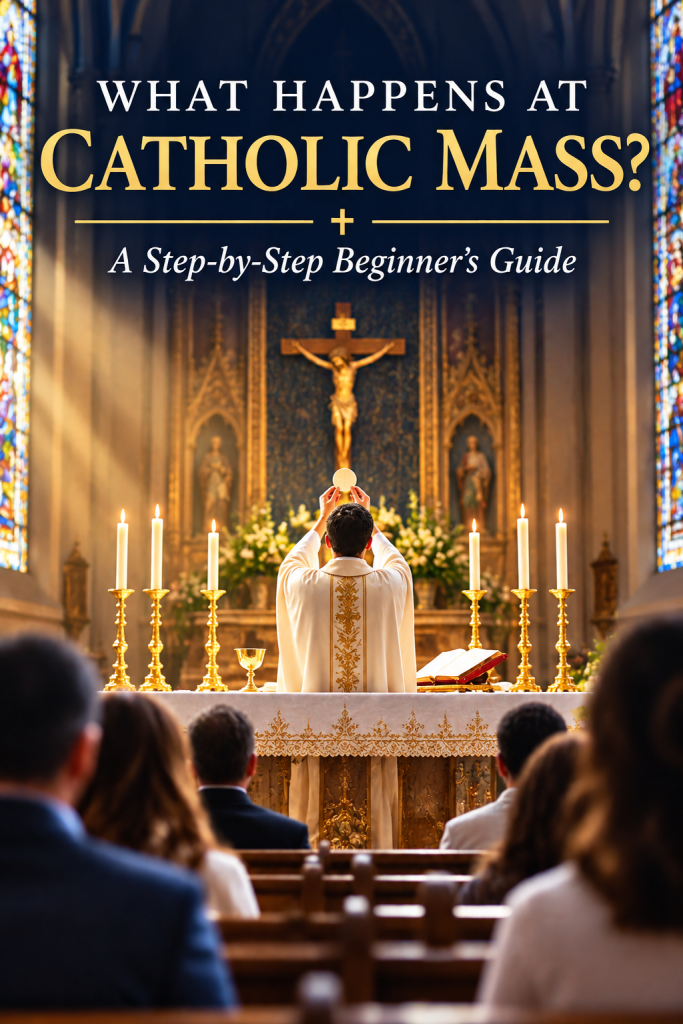
The priest elevates the consecrated host and then the chalice.
Some churches ring bells during these moments.
The congregation ordinarily kneels in adoration.
This is the doctrine of the Real Presence made visible within Catholic worship: Catholics believe Jesus Christ is truly present—Body, Blood, Soul, and Divinity—in the Eucharist.
Suggested Scripture: Matthew 26:26–29; Luke 22:14–20; 1 Corinthians 11:23–26
Is Jesus Sacrificed Again at Every Mass?
No.
This is an important distinction, particularly for people unfamiliar with Catholic teaching.
Catholics do not believe Jesus is repeatedly crucified.
Christ’s sacrifice on Calvary occurred once for all.
At Mass, the Church teaches that Christ’s one sacrifice is made sacramentally present.
The Mass and Calvary are therefore not competing sacrifices.
The Eucharistic celebration participates sacramentally in the one saving sacrifice of Christ.
Suggested Scripture: Hebrews 9:24–28; Hebrews 10:10–14
The Mystery of Faith
After the consecration, the priest announces the Mystery of Faith.
The congregation responds with an acclamation proclaiming Christ’s death and Resurrection and looking forward to His coming again.
This reinforces an essential truth:
The Eucharist cannot be separated from the Paschal Mystery—Christ’s Passion, death, Resurrection, and glorification.
The Great Amen
The Eucharistic Prayer concludes with a great expression of praise to the Trinity.
The congregation responds:
Amen.
This Great Amen expresses the people’s assent to the Eucharistic Prayer that has just been offered.
Mass then moves into the Communion Rite.
The Lord’s Prayer — The Our Father
The congregation stands and prays the prayer Jesus taught His disciples: the Our Father.
The Lord’s Prayer is especially appropriate here.
The congregation is preparing to receive the Eucharist, and in the Our Father Christians ask God for their daily bread.
The prayer also asks for forgiveness and the grace to forgive others.
Suggested Scripture: Matthew 6:9–13
The Sign of Peace
The priest prays for Christ’s peace and may invite the congregation to offer one another a Sign of Peace.
The exact gesture varies by culture and circumstance.
The point is not simply to greet friends.
The gesture expresses reconciliation and peace within the Body of Christ immediately before Communion.
Lamb of God — Agnus Dei
As the consecrated host is broken, the congregation prays the Lamb of God, asking Christ for mercy and peace.
The title Lamb of God carries deep biblical significance.
It recalls the Passover lamb, the sacrificial imagery of the Old Testament, and John the Baptist’s identification of Jesus as the Lamb of God.
Suggested Scripture: John 1:29; Exodus 12:1–14; Revelation 5:6–14
Behold the Lamb of God
The priest then presents the Eucharist to the congregation as the Lamb of God.
The faithful respond with words based upon the faith of the Roman centurion, acknowledging their unworthiness while trusting in Christ’s power to heal.
This prayer expresses both humility and faith immediately before receiving Christ.
Suggested Scripture: Matthew 8:5–13
Holy Communion
The congregation begins approaching the altar.
Catholics who are properly disposed receive the Eucharist.
When the minister presents the consecrated host and says “The Body of Christ,” the communicant responds:
Amen.
That Amen is important.
It is an expression of faith—an affirmation of what the Church believes about the Eucharist.
Catholics may receive according to the approved practices of the Church and local norms.
After receiving Communion, the faithful return to their places and ordinarily spend time in prayer.
Who Can Receive Communion at Catholic Mass?
This is one of the most important practical questions for first-time visitors.
A non-Catholic is generally welcome to attend Catholic Mass, but ordinarily should not receive Holy Communion.
This is not intended as a statement that visitors are unwelcome.
For Catholics, receiving Communion expresses not only personal belief in Christ but also sacramental communion with the Catholic Church and its Eucharistic faith.
Catholics themselves must also be properly disposed to receive Communion.
If you are visiting and are unsure what to do, you can simply remain in your pew during Communion.
There is nothing embarrassing or disrespectful about doing so.
Practices regarding approaching the Communion line without receiving can vary, so following the guidance of the particular parish is preferable.
What Should You Do After Receiving Communion?
The period after Communion is a particularly appropriate time for thanksgiving.
You do not need an elaborate prayer.
You might simply pray:
Jesus, thank You for giving Yourself to me. Help me remain close to You and live according to Your will.
You can also sit or kneel silently.
The point is not to immediately begin thinking about leaving.
Catholics believe they have just received Christ sacramentally. A few moments of attentive thanksgiving are therefore deeply appropriate. Bringing that spirit of thanksgiving into the rest of the week can also become part of a consistent daily Catholic prayer routine.
The Prayer After Communion
After Communion has concluded, the priest offers the Prayer after Communion.
This prayer asks that the sacrament just received bear fruit in the lives of the faithful.
The Mass then moves toward its conclusion.
The Concluding Rites
The final portion of Mass is brief but meaningful.
Announcements may sometimes be given.
The priest blesses the congregation in the name of the Trinity.
Then comes the dismissal.
The Dismissal: Why Mass Ends by Sending Catholics Out
The dismissal may sound like a simple announcement that Mass is over.
It is more than that.
The congregation is sent.
Having heard God’s Word and received the Eucharist, Catholics are called to bring Christ into the world through their lives.
The Mass therefore has a movement:
Gather → Listen → Receive → Go
Catholic worship should lead to Christian action.
The faithful leave church called to love their neighbors, forgive, serve people in need, defend human dignity, practice charity, and bear witness to the Gospel.
The dismissal is not merely permission to leave.
It is a mission.
Why Do Catholics Stand, Sit, and Kneel So Much?
First-time visitors often notice the changing postures.
Each has meaning.
Standing commonly expresses respect, readiness, and participation.
Sitting is associated particularly with attentive listening and reflection.
Kneeling expresses adoration, humility, and reverence.
Catholic worship involves the body because Christianity understands the human person as a unity of body and soul.
We do not worship God only with our thoughts.
Our bodies participate too.
Can a Non-Catholic Attend Catholic Mass?
Yes.
Visitors are generally welcome at Catholic Mass.
You do not need to know all the responses or gestures.
You can simply observe respectfully.
If everyone stands, you may stand. If you are uncomfortable participating in a particular gesture, quietly remaining respectful is fine.
You are not expected to pretend to know what you don’t know.
The main exception to general participation is Holy Communion, which has particular requirements because of what Communion signifies in Catholic faith.
If you are curious about Catholicism, attending Mass can be one of the best ways to begin understanding how Catholics actually worship.
What Should I Wear to Catholic Mass?
There is no universal Catholic dress code requiring a particular style of clothing for ordinary parish Mass.
Customs vary significantly by parish, culture, climate, and occasion.
A useful principle is simply to dress respectfully and modestly, recognizing that you are entering a place of worship.
You do not need expensive or formal clothing to attend Mass.
The Church is not meant to be a fashion competition.
Reverence matters more than status.
How Long Is Catholic Mass?
A typical Sunday Mass often lasts around an hour, although the length varies.
Weekday Masses are often shorter.
Major celebrations such as the Easter Vigil can be considerably longer.
The length can also vary depending on music, the homily, special rites, the number of people receiving Communion, and the particular celebration.
Why Is There So Much Repetition at Mass?
Catholic liturgy intentionally uses repeated prayers and structures.
Repetition does not necessarily make prayer meaningless.
Human life contains meaningful repetition everywhere: expressions of love, family traditions, anniversaries, songs, and rituals.
Within Mass, repeated words allow Catholics to internalize the faith.
The goal is not merely to say familiar words automatically but to enter more deeply into what those words mean.
The challenge for lifelong Catholics is therefore not eliminating repetition.
It is resisting mindless repetition.
How Can I Get More Out of Catholic Mass?
You don’t need to redesign the Mass to experience it more deeply.
Often the best approach is to become more attentive to what is already happening.
Read the Scripture Readings Before Mass
Spend 10–15 minutes with the readings beforehand.
You’ll recognize them when they are proclaimed and may understand the homily more easily.
Arrive Early
Even five minutes of silence can make a significant difference.
Listen to the Prayers
Pay particular attention to the Eucharistic Prayer.
You may be surprised by how much theology is contained within prayers you’ve heard many times.
Watch the Altar
Notice the gestures surrounding the Eucharist.
Understanding what they signify makes them far more meaningful.
Participate
Sing.
Respond.
Pray.
Listen.
Catholic liturgy is not intended to be watched as a performance.
Pray After Communion
Don’t rush through one of the most important moments of Mass.
Stay for the Dismissal
The final blessing and dismissal are part of Mass.
Allow yourself to be sent into the world rather than mentally leaving several minutes early.
Catholic Mass and Eucharistic Adoration
Mass and Eucharistic Adoration are intimately connected but are not the same thing.
The Mass is the Church’s Eucharistic celebration in which the sacrifice of Christ is sacramentally made present and the faithful receive Holy Communion.
During Eucharistic Adoration, Catholics worship Christ present in the Blessed Sacrament outside the celebration of Mass.
Adoration therefore flows from the Mass and should lead Catholics back toward a deeper participation in it.
If you’ve ever wondered what people actually do while sitting before the Blessed Sacrament, our Complete Beginner’s Guide to Eucharistic Adoration walks through it step by step.
Frequently Asked Questions About Catholic Mass
Do I Have to Be Catholic to Attend Mass?
No. Visitors are generally welcome to attend respectfully.
Can I Receive Communion If I’m Not Catholic?
Ordinarily, non-Catholics do not receive Holy Communion at Catholic Mass. Communion expresses a particular sacramental and ecclesial unity.
What If I Don’t Know the Responses?
That’s completely fine. Listen and follow along as you’re comfortable. Many parishes provide worship aids or missals.
Do I Have to Genuflect?
Catholic genuflection is an act of reverence toward Christ in the Eucharist. A visitor unfamiliar or uncomfortable with the gesture does not need to imitate something he or she does not understand.
Why Does Everyone Kneel During the Eucharistic Prayer?
Kneeling expresses adoration and reverence during the central Eucharistic portion of Mass.
Is Every Catholic Mass Basically the Same?
The fundamental structure of the Roman Rite is consistent, although music, language, local customs, solemnity, and certain options can vary.
Other Catholic liturgical traditions also exist, including Eastern Catholic rites, whose liturgies have different forms while remaining fully Catholic.
What Is the Most Important Part of Mass?
It is better not to think of Mass as a collection of unrelated pieces competing for importance.
The Liturgy of the Word and Liturgy of the Eucharist together form one act of worship, with the Eucharistic sacrifice at the heart of the celebration.
What Happens If I Make a Mistake?
Nothing disastrous.
If you stand when everyone sits or lose your place in the responses, simply follow along.
Mass is worship, not an examination.
From the Church Door to the Dismissal
Once you understand its structure, Catholic Mass begins to look much less mysterious.
You enter and remember your Baptism.
You acknowledge God’s presence.
You confess your need for mercy.
You praise God.
You hear Sacred Scripture.
You listen to the Gospel.
You profess the faith.
You pray for the world.
You bring gifts to the altar.
You join the Church’s great prayer of thanksgiving.
You kneel as the Eucharist is consecrated.
You pray the prayer Jesus taught.
You prepare for Communion.
You receive Christ—or, if you are not receiving, remain prayerfully present.
You give thanks.
And then you are sent back into the world.
Every part points toward a larger reality.
Catholic worship is not meant to end at the church doors.
Conclusion: Come and Experience the Mass
Understanding the Catholic Mass takes time.
Someone can attend Mass for decades and continue discovering new layers of meaning in its Scripture, prayers, symbols, gestures, and silence.
For the first-time visitor, however, the most important thing is not memorizing every response.
Begin by observing.
Listen to the Scriptures.
Notice the movement from the Liturgy of the Word to the Liturgy of the Eucharist.
Watch what happens at the altar.
Listen carefully to the words of the Eucharistic Prayer.
Notice the silence after Communion.
And remember what Catholics believe is at the center of it all.
The Mass is ultimately about Jesus Christ.
Catholics gather because of Him.
They hear His Gospel.
They remember and participate sacramentally in His saving sacrifice.
They believe He becomes truly present in the Eucharist.
They receive Him in Holy Communion.
And then they are sent into the world to live what they have celebrated.
If you are Catholic and Mass has begun to feel routine, learning what each part means can help you encounter familiar prayers with renewed attention.
If you are not Catholic but are curious about the Church, you are welcome to attend Mass respectfully and experience Catholic worship firsthand.
And if one particular part of the Mass raises more questions, keep exploring.
Understanding the Eucharist, Scripture, prayer, and Catholic worship is not something completed in a single afternoon.
It is a journey deeper into the heart of the Christian faith.