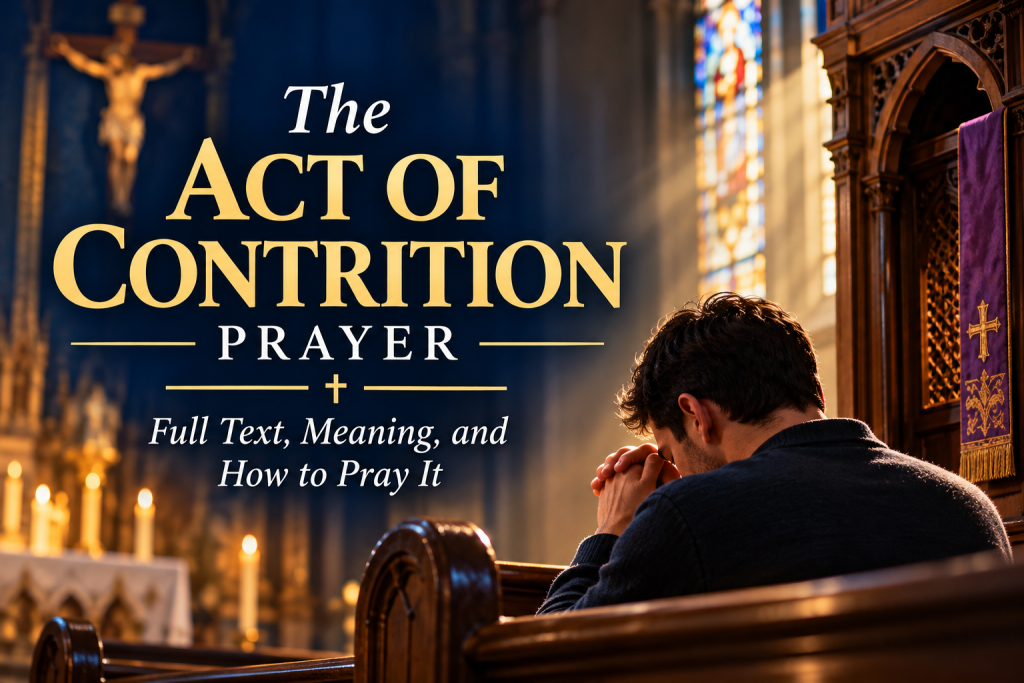
Act of Contrition Prayer: Full Text, Meaning, and How to Pray It
The Act of Contrition prayer is one of the most important traditional prayers in the Catholic Church. It expresses sorrow for sin, asks God for forgiveness, and renews our commitment to turn away from wrongdoing and follow Jesus Christ.
For generations, Catholics have prayed the Act of Contrition during the Sacrament of Reconciliation, in personal prayer, and when examining their conscience before God.
Whether you are preparing for your first Confession, returning to the sacrament after many years, or simply looking for the words of this beautiful Catholic prayer, understanding the Act of Contrition can help deepen your relationship with God.
At its heart, the prayer is about more than admitting mistakes. It is about recognizing God’s mercy, accepting responsibility for our actions, and sincerely desiring to live differently.
Below, you’ll find the full Act of Contrition prayer, an explanation of its meaning, alternative versions, biblical foundations, and a practical guide to praying it.
Act of Contrition Prayer — Full Traditional Text
One of the most familiar traditional Catholic versions reads:
O my God,
I am heartily sorry for having offended Thee,
and I detest all my sins
because I dread the loss of heaven and the pains of hell,
but most of all because they offend Thee, my God,
who art all good and deserving of all my love.
I firmly resolve, with the help of Thy grace,
to confess my sins,
to do penance,
and to amend my life.
Amen.
This traditional wording remains familiar to many Catholics, particularly those who learned their prayers during childhood.
Although some expressions, such as “Thee” and “Thy,” may sound old-fashioned, they communicate a timeless spiritual message: sincere sorrow, love for God, and a determination to change.
There are also other approved and commonly used forms of the Act of Contrition. The essential elements are sincere repentance and a genuine intention to turn away from sin.
What Is the Act of Contrition?
The Act of Contrition is a Catholic prayer expressing repentance for sins committed against God and others.
The word contrition refers to sorrow of the soul and rejection of sin, together with the intention not to sin again.
In Catholic teaching, contrition is an essential part of conversion and reconciliation with God.
The Catechism of the Catholic Church, paragraph 1451, describes contrition as sorrow for sin accompanied by the resolution not to sin again.
This means that contrition involves more than feeling guilty or embarrassed.
A person may regret being caught doing something wrong without genuinely regretting the wrongdoing itself. True contrition goes deeper. It recognizes that sin damages our relationship with God, harms others, and leads us away from the life we are called to live.
The Act of Contrition gives words to that recognition.
It is both a confession of sorrow and a declaration of hope.
When Catholics pray it sincerely, they acknowledge their need for God’s forgiveness while trusting in His willingness to welcome those who repent.
What Does the Act of Contrition Mean? A Line-by-Line Explanation
Understanding the words can make the prayer much more meaningful.
Rather than simply reciting a familiar formula, Catholics can use each line as an opportunity for reflection.
“O my God”
The prayer begins by addressing God personally.
Repentance is not merely an internal conversation about our shortcomings. It is an act of turning toward the God who created us, loves us, and calls us into communion with Him.
These opening words remind us that prayer is fundamentally relational.
We are speaking to someone who knows us completely and whose mercy is greater than our sins.
“I am heartily sorry for having offended Thee”
The word “heartily” expresses sincere, heartfelt sorrow.
The person praying acknowledges having acted against God’s will.
This is not intended to encourage hopelessness or excessive self-condemnation. Instead, it recognizes that our choices have spiritual consequences.
Catholic repentance begins with honesty.
We cannot seek healing while refusing to acknowledge what needs to be healed.
“And I detest all my sins”
This phrase expresses a rejection of sin itself.
It does not mean that we should hate ourselves.
Catholic Christianity distinguishes between the dignity of the human person and the wrongness of sinful actions.
God’s love for the sinner remains, even when the person has acted contrary to His commandments.
To detest sin is to recognize that it separates us from the goodness, holiness, and love for which we were created.
“Because I dread the loss of heaven and the pains of hell”
This line acknowledges the serious consequences of turning away from God.
Catholic teaching recognizes that fear of punishment can motivate someone to repent.
Such fear is not necessarily the highest form of repentance, but it can be the beginning of a genuine return to God.
The Church distinguishes between imperfect contrition, which may arise from fear of punishment or recognition of sin’s ugliness, and perfect contrition, which arises from love of God above all else.
Both are important concepts in understanding the Sacrament of Reconciliation.
“But most of all because they offend Thee, my God”
Here the prayer moves beyond fear.
The person praying recognizes that sin is wrong above all because it is contrary to the love and goodness of God.
This is one of the most important lines in the traditional Act of Contrition.
It shifts the focus from consequences to relationship.
We are sorry not only because wrongdoing can bring suffering, but because we love God and do not want to turn away from Him.
“Who art all good and deserving of all my love”
God’s goodness is the foundation of Christian repentance.
The prayer does not describe God as someone waiting eagerly to punish every mistake.
Instead, it acknowledges that God is perfectly good and worthy of our love.
Repentance becomes a response to divine goodness.
The more deeply we recognize God’s love, the more clearly we can understand why sin is something to reject.
“I firmly resolve, with the help of Thy grace”
Sincere contrition includes the intention to change.
However, the prayer also acknowledges that lasting conversion requires God’s grace.
Catholics do not believe that holiness is achieved through human effort alone.
God strengthens believers through prayer, the sacraments, and the work of the Holy Spirit.
This line is especially encouraging for people struggling with repeated sins.
The intention to avoid sin must be genuine, even though a person cannot guarantee that they will never fall again.
“To confess my sins, to do penance, and to amend my life”
The final promises give repentance a practical direction.
Confessing sins means bringing them honestly before God and, when required, receiving sacramental absolution through the Sacrament of Reconciliation.
Doing penance expresses a willingness to cooperate with God’s grace and take meaningful steps toward spiritual healing.
Amending one’s life means sincerely intending to avoid sin and its occasions.
The prayer therefore ends not with despair, but with a commitment to renewal.
When Do Catholics Pray the Act of Contrition?
Although the Act of Contrition is strongly associated with Confession, Catholics may pray it in several circumstances.
During the Sacrament of Reconciliation
The most familiar setting is Confession.
After confessing sins and receiving guidance from the priest, the penitent is ordinarily invited to express contrition.
Many Catholics recite a memorized Act of Contrition at this point.
Others use an alternative form expressing sincere sorrow and a resolution to avoid sin.
During an Examination of Conscience
An examination of conscience is a prayerful reflection on our actions, attitudes, and decisions.
Catholics may consider whether they have loved God and neighbor, fulfilled their responsibilities, spoken truthfully, forgiven others, and acted with charity.
Praying the Act of Contrition afterward can help transform reflection into repentance.
Before Going to Sleep
Evening prayer offers an opportunity to review the day.
If you’re looking to make evening reflection a regular habit, our Daily Catholic Prayer Routine offers practical guidance for building a consistent prayer life.
A Catholic might thank God for blessings, acknowledge mistakes, ask forgiveness, and resolve to begin again the following morning.
The Act of Contrition fits naturally into this practice.
After Recognizing a Sin
A person does not have to wait until the next scheduled Confession to turn toward God.
Whenever someone becomes aware of wrongdoing, they can immediately ask for mercy and make a sincere act of repentance.
However, personal prayer does not ordinarily replace sacramental Confession for mortal sins.
How to Pray the Act of Contrition During Confession
For someone who has not been to Confession in years, the experience may feel intimidating.
Fortunately, the basic process is straightforward.
Step 1: Prepare Through an Examination of Conscience
Before entering the confessional, spend time reflecting honestly on your sins.
Ask the Holy Spirit for guidance and consider the Ten Commandments, the teachings of Jesus, and your responsibilities toward others.
The purpose is not to create anxiety. It is to prepare for an honest encounter with God’s mercy.
Step 2: Begin Your Confession
After greeting the priest, make the Sign of the Cross.
You can tell the priest approximately how long it has been since your last Confession.
If you are nervous or unfamiliar with the process, simply say so.
The priest can guide you.
Step 3: Confess Your Sins
Speak honestly about the sins you have committed.
Catholic teaching requires the confession of all remembered mortal sins in kind and number, following a diligent examination of conscience.
You do not need to tell an elaborate story about every circumstance.
The priest may offer advice, encouragement, or clarification.
Step 4: Receive Your Penance
The priest assigns a penance, which may involve prayer or another appropriate action.
Penance is not a way of purchasing God’s forgiveness.
Rather, it is part of the sacrament’s process of conversion and spiritual healing.
Step 5: Pray the Act of Contrition
The priest will invite you to express sorrow for your sins.
You can recite the traditional prayer or another suitable form.
Pray slowly enough to understand what you are saying.
The purpose is not perfect memorization but sincere repentance.
Step 6: Receive Absolution
The priest pronounces the prayer of absolution.
Through the ministry of the Church, God grants sacramental forgiveness to the properly disposed penitent.
Afterward, the priest dismisses you.
Complete your assigned penance as soon as reasonably possible.
Remember that Confession is not intended to humiliate you. It is a sacrament of mercy, healing, and reconciliation.
A Short Act of Contrition Prayer
Some Catholics prefer a shorter prayer that is easier to memorize.
The following is a simple personal prayer of contrition:
My God,
I am sorry for my sins.
I have chosen to do wrong
and failed to do good.
With Your help,
I will turn away from sin
and follow Jesus more faithfully.
Have mercy on me, Lord.
Amen.
This is an original short prayer suitable for personal devotion. During sacramental Confession, follow the priest’s guidance regarding the form of contrition.
The most important element is not the length of the prayer, but the sincerity of the repentance it expresses.
Perfect Contrition vs. Imperfect Contrition
Catholic teaching recognizes two forms of contrition.
Understanding the difference helps explain why the traditional Act of Contrition mentions both fear of punishment and love for God.
What Is Perfect Contrition?
Perfect contrition arises from love of God above all else.
A person recognizes that sin is wrong principally because it offends the God who is infinitely good and worthy of love.
According to Catholic teaching, perfect contrition can obtain forgiveness of mortal sins when it includes the firm resolution to receive sacramental Confession as soon as possible.
It is not a reason to disregard the Sacrament of Reconciliation.
Instead, it expresses a profound movement of the heart toward God.
What Is Imperfect Contrition?
Imperfect contrition, sometimes called attrition, may arise from fear of eternal punishment or recognition of sin’s ugliness.
Although it does not arise from the same fullness of love as perfect contrition, the Church teaches that it is a gift of God and a prompting of the Holy Spirit.
Imperfect contrition disposes a person to receive forgiveness in the Sacrament of Reconciliation.
The distinction reminds Catholics that conversion is often a process.
A person may begin by fearing the consequences of wrongdoing and gradually grow toward repentance motivated primarily by love.
Suggested Scripture: Psalm 51:1–12; Luke 15:11–32
The Biblical Foundations of the Act of Contrition
The exact traditional wording of the Act of Contrition is not taken from a single biblical passage.
Nevertheless, its themes are deeply rooted in Sacred Scripture.
Psalm 51: A Prayer of Repentance
Psalm 51 is among the most powerful biblical expressions of sorrow for sin.
Traditionally associated with King David’s repentance, the psalm acknowledges wrongdoing while appealing to God’s mercy.
Its central message is that God desires genuine repentance rather than merely outward religious actions.
Suggested Scripture: Psalm 51:1–19
The Prodigal Son: Returning to the Father
In Luke 15, Jesus tells the parable of a son who abandons his father, wastes his inheritance, and eventually returns home.
The father’s response is extraordinary.
Rather than rejecting his son, he welcomes him with compassion and joy.
The parable illustrates the mercy of God toward those who sincerely return to Him.
The Act of Contrition expresses a similar movement: recognition of sin, sorrow, and the decision to return.
Suggested Scripture: Luke 15:11–32
The Tax Collector’s Prayer
Jesus also tells a parable about a Pharisee and a tax collector praying in the Temple.
The tax collector humbly acknowledges his sinfulness and asks God for mercy.
Jesus presents his humility as an example of authentic prayer.
This passage reminds us that repentance does not require impressive language.
It requires honesty before God.
Suggested Scripture: Luke 18:9–14
Jesus Gives the Apostles Authority to Forgive Sins
In John’s Gospel, the risen Jesus appears to His disciples, gives them the Holy Spirit, and speaks about the forgiveness of sins.
The Catholic Church understands this passage as an important biblical foundation for the Sacrament of Reconciliation.
Suggested Scripture: John 20:19–23
Why Is Contrition Important in Catholic Life?
Contrition is not limited to the confessional.
It belongs to the broader Christian calling to ongoing conversion.
Every Christian continues to struggle with temptation, weakness, selfishness, and imperfect love.
The spiritual life therefore requires a willingness to recognize mistakes and return to God.
Without contrition, religious practice can become superficial.
A person may attend Mass, recite prayers, or participate in parish activities while refusing to acknowledge harmful behavior.
Genuine repentance challenges that contradiction.
It invites Catholics to examine not only obvious wrongdoing but also their attitudes toward others.
Have we been impatient with family members?
Have we ignored someone who needed help?
Have we allowed resentment to grow?
Have we spoken carelessly or failed to act with compassion?
These questions are not intended to produce constant guilt.
They help us become more attentive to the ways God’s grace is calling us to grow.
The Act of Contrition gives that process a simple and memorable expression.
How to Make the Act of Contrition Part of Your Daily Prayer Routine
You do not need to wait until Confession to pray the Act of Contrition.
One practical approach is to include it in your evening prayers.
Begin by thanking God for something good that happened during the day.
Then ask the Holy Spirit to help you reflect honestly.
Consider where you acted with love and where you fell short.
If you recognize a sin, acknowledge it without making excuses.
Pray the Act of Contrition slowly.
Finally, ask God for the grace to act differently tomorrow.
This practice can take only a few minutes, but over time it may encourage greater self-awareness, humility, and spiritual growth.
For those developing a consistent habit of prayer, the Act of Contrition can complement familiar prayers such as the Our Father, Hail Mary, and Glory Be.
It can also help prepare the heart for a more meaningful celebration of the Sacrament of Reconciliation.
Common Questions About the Act of Contrition
Do I Have to Memorize the Act of Contrition for Confession?
No. Memorization is helpful, but sincere contrition is more important than reciting a particular formula perfectly.
If you forget the words, tell the priest. He can help you express your sorrow.
Is There Only One Correct Act of Contrition?
No. Several traditional and approved forms exist.
Different generations and Catholic communities may be familiar with different wording.
The essential elements are repentance and a genuine resolution to avoid sin.
Can I Pray the Act of Contrition at Home?
Yes. Catholics are encouraged to repent and ask God’s forgiveness whenever they recognize sin.
However, personal prayer does not ordinarily replace sacramental Confession when mortal sin has been committed.
Does Praying the Act of Contrition Automatically Forgive Mortal Sins?
Not simply because the words have been recited.
The Church teaches that perfect contrition, including the intention to confess as soon as possible, obtains forgiveness of mortal sins.
Ordinarily, Catholics conscious of mortal sin should receive sacramental absolution before receiving Holy Communion.
What If I Keep Committing the Same Sin?
Repeated struggles do not necessarily mean that your repentance is insincere.
A genuine resolution to avoid sin does not require certainty that you will never fall again.
Continue seeking God’s grace, honestly examine the circumstances that lead to temptation, and receive appropriate spiritual guidance.
Can Children Pray the Act of Contrition?
Yes. Many Catholic children learn the prayer while preparing for First Reconciliation.
Parents and catechists can explain its meaning in age-appropriate language so children understand that God’s mercy is central to the sacrament.
When Is the Best Time to Pray the Act of Contrition?
It is especially appropriate during Confession, after an examination of conscience, and during evening prayer.
However, there is no restriction limiting it to a particular time of day.
The Act of Contrition and God’s Mercy
One of the most beautiful aspects of Catholic teaching on repentance is that forgiveness begins with God’s initiative.
God does not wait for human beings to become perfect before offering His grace.
Throughout Scripture, He continually calls His people back to Himself.
Jesus’ ministry is filled with encounters involving sinners, outcasts, and people seeking a new beginning.
He calls them to conversion while revealing the compassion of the Father.
The Act of Contrition reflects this relationship between mercy and repentance.
We acknowledge our sins because we believe that God is good.
We resolve to change because His grace makes conversion possible.
And we approach Confession not because we have already achieved holiness, but because we need the healing and forgiveness Christ offers.
For Catholics who have been away from the sacrament for many years, this is especially important.
Returning to Confession does not require having every part of life figured out.
It begins with a willingness to turn toward God.
Conclusion: A Prayer of Sorrow, Hope, and Renewal
The Act of Contrition is much more than a prayer memorized for First Confession.
It is a lasting expression of the Christian journey toward conversion.
Its words teach us to acknowledge sin honestly, trust in God’s mercy, reject what separates us from Him, and seek the grace to live differently.
The prayer begins with sorrow, but it does not end there.
It leads toward hope.
Each time Catholics sincerely pray the Act of Contrition, they are reminded that repentance is not simply about looking backward at mistakes.
It is about turning forward toward God.
Whether prayed in the confessional, beside a bed at night, or during a quiet moment of personal reflection, the Act of Contrition offers a simple invitation:
Recognize your sins, trust in God’s mercy, and begin again with His grace.
Continue Exploring Catholic Prayer
The Act of Contrition is one of many traditional prayers that can deepen your spiritual life.
Continue exploring Catholic prayer and spirituality through these related topics:
- The Our Father: The prayer Jesus taught His disciples and a foundation of Christian prayer.
- The Glory Be: A short prayer praising the Father, Son, and Holy Spirit.
- How to Build a Daily Catholic Prayer Routine: Practical guidance for developing a consistent habit of prayer.
- How to Pray the Rosary: A step-by-step guide to one of Catholicism’s most beloved devotions.
- What Happens at Catholic Mass?: A beginner-friendly explanation of Catholic worship, Scripture, and the Eucharist.