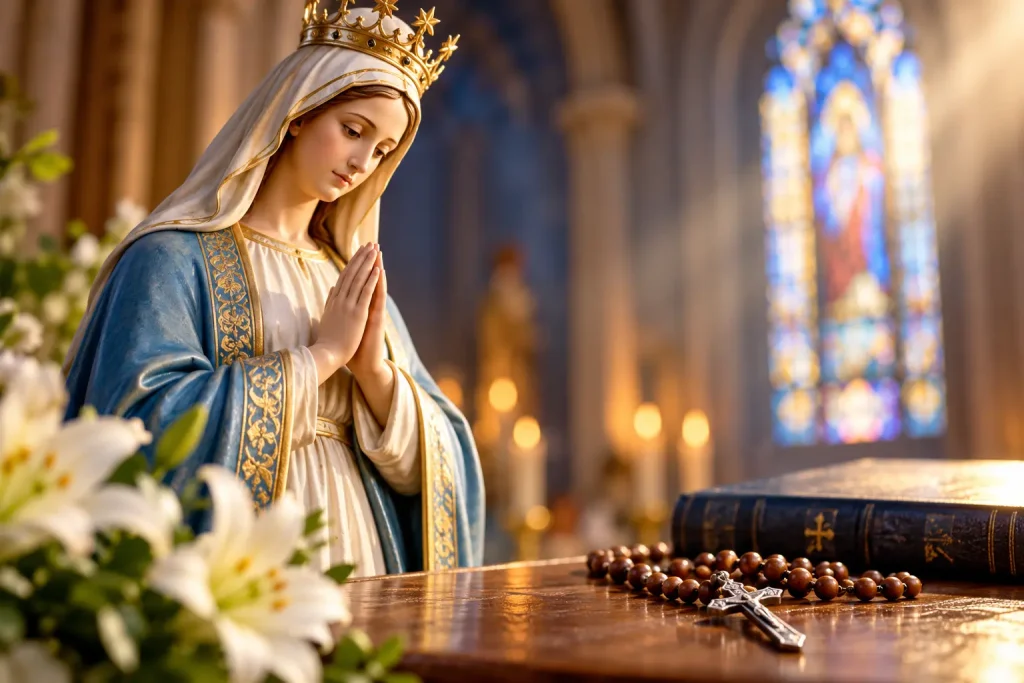
The Hail Holy Queen prayer, also known by its Latin name Salve Regina, is one of the most beloved Marian prayers in the Catholic Church. For centuries, Catholics have turned to the Blessed Virgin Mary with these beautiful words, asking for her intercession, guidance, and maternal care.
In this article
Often recited at the conclusion of the Rosary, the Hail Holy Queen expresses the Christian longing for heaven and reminds believers of the hope found in Jesus Christ. Its words speak of mercy, suffering, perseverance, and the loving presence of Mary in the spiritual lives of the faithful.
The prayer begins by addressing Mary as the “Mother of mercy” and concludes by asking her to pray for us so that we may become worthy of the promises of Christ.
Whether you are learning the prayer for the first time, preparing to pray the Rosary, or seeking to understand its deeper spiritual meaning, the Hail Holy Queen offers a powerful expression of Catholic faith and devotion.
In this complete guide, we will explore the full Hail Holy Queen prayer, its meaning line by line, its Latin origins, its biblical foundations, and how to incorporate it into your daily prayer life.
Hail Holy Queen Prayer — Full Traditional Text
The traditional English version of the Hail Holy Queen prayer reads:
Hail, Holy Queen, Mother of Mercy,
our life, our sweetness, and our hope.
To thee do we cry, poor banished children of Eve.
To thee do we send up our sighs,
mourning and weeping in this valley of tears.
Turn then, most gracious advocate,
thine eyes of mercy toward us,
and after this our exile,
show unto us the blessed fruit of thy womb, Jesus.
O clement, O loving, O sweet Virgin Mary.
V. Pray for us, O holy Mother of God.
R. That we may be made worthy of the promises of Christ.
Amen.
The prayer is traditionally followed by the versicle and response shown above, particularly when recited as part of the Rosary.
The Hail Holy Queen is both a prayer of petition and an expression of hope. Catholics ask Mary to intercede for them, especially during times of suffering, temptation, uncertainty, and spiritual difficulty.
Its ultimate focus is Jesus Christ, whom Mary is asked to show to the faithful at the end of their earthly pilgrimage.
Hail Holy Queen Prayer in Latin — Salve Regina
The Hail Holy Queen is traditionally known as the Salve Regina, meaning “Hail, Queen.”
The Latin text is especially familiar in monasteries, religious communities, and churches where Gregorian chant remains part of the liturgical and devotional tradition.
Traditional Latin Text
Salve, Regina, mater misericordiae,
vita, dulcedo, et spes nostra, salve.
Ad te clamamus, exsules filii Hevae.
Ad te suspiramus, gementes et flentes
in hac lacrimarum valle.
Eia ergo, advocata nostra,
illos tuos misericordes oculos ad nos converte.
Et Iesum, benedictum fructum ventris tui,
nobis post hoc exsilium ostende.
O clemens, O pia, O dulcis Virgo Maria.
The Latin text conveys the same essential message as the familiar English translation: an appeal to Mary’s mercy and intercession, and a longing to see Jesus Christ.
The traditional versicle and response may also be prayed in Latin:
V. Ora pro nobis, sancta Dei Genetrix.
R. Ut digni efficiamur promissionibus Christi.
For Catholics interested in the Church’s rich musical heritage, the Salve Regina is also among the most recognizable Marian chants.
Its melody has been sung for centuries, helping generations of believers express their devotion through sacred music.
For another reference, EWTN’s Salve Regina resource provides the traditional prayer in both English and Latin, along with its concluding prayers.
What Is the Hail Holy Queen Prayer?
The Hail Holy Queen is a traditional Catholic prayer addressed to the Blessed Virgin Mary, asking for her intercession and expressing confidence in her maternal care.
It belongs to a group of Marian prayers known as Marian antiphons, which have long been associated with the Church’s liturgical prayer.
The four traditional Marian antiphons are:
- Alma Redemptoris Mater
- Ave Regina Caelorum
- Regina Caeli
- Salve Regina
Each honors Mary in relation to her unique role in the mystery of Jesus Christ.
The Salve Regina is particularly associated with the period after Pentecost in the traditional seasonal arrangement of Marian antiphons.
It is also commonly prayed at the conclusion of the Rosary, making it familiar to Catholics around the world.
Although the prayer uses affectionate titles such as “our life,” “our sweetness,” and “our hope,” these expressions must be understood within Catholic teaching.
Mary is not the source of salvation.
Jesus Christ alone is the Savior of the world.
Catholic devotion to Mary recognizes her as the Mother of God and asks for her prayers, while all saving grace ultimately comes from God through Jesus Christ.
What Does the Hail Holy Queen Mean? A Line-by-Line Explanation
The Hail Holy Queen contains beautiful expressions that may seem unfamiliar to modern readers.
Understanding its language can help Catholics pray with greater attention and devotion.
“Hail, Holy Queen, Mother of Mercy”
The opening words honor Mary as Queen and Mother of Mercy.
Catholics recognize Mary as Queen because of her unique relationship with Jesus Christ, the King of Kings.
Her queenship does not mean that she possesses divine authority independent of God.
Rather, it reflects her participation in the glory of her Son.
The title “Mother of Mercy” emphasizes Mary’s maternal compassion and her relationship with Jesus, who reveals the mercy of God.
When Catholics address Mary in this way, they ask her to intercede for them before her Son.
“Our life, our sweetness, and our hope”
These words express deep affection and trust.
They do not suggest that Mary replaces Christ as the source of eternal life or Christian hope.
Instead, they reflect the language of Catholic devotion, which recognizes Mary’s maternal role in leading believers closer to Jesus.
Mary’s example encourages Christians to trust God’s promises even when circumstances are difficult.
At the Annunciation, she accepted God’s will with faith and humility.
At the foot of the Cross, she remained close to her suffering Son.
Her life demonstrates perseverance, obedience, and hope.
Catholics therefore look to Mary as an example of faithful discipleship.
“To thee do we cry, poor banished children of Eve”
This phrase connects the prayer to the biblical account of humanity’s fall.
Eve is presented in Genesis as the mother of the living, while the consequences of sin introduce suffering and death into human experience.
Catholic tradition has often described Mary as the New Eve, emphasizing her faithful cooperation with God’s plan of salvation.
Where Eve’s disobedience is associated with humanity’s fall, Mary’s obedience is associated with the coming of Jesus Christ, the New Adam.
The phrase “banished children of Eve” expresses the human condition of living in a world affected by sin and longing for full communion with God.
It reminds believers that earthly life is a pilgrimage toward their heavenly home.
“To thee do we send up our sighs, mourning and weeping in this valley of tears”
The expression “valley of tears” describes the suffering and sorrow that accompany human life.
Every person experiences difficulties.
Illness, grief, disappointment, loneliness, uncertainty, and the loss of loved ones can make life feel overwhelming.
The prayer acknowledges these realities without suggesting that earthly life is without goodness or joy.
Instead, it recognizes that human existence is marked by both beauty and suffering.
Catholics turn to Mary as a compassionate mother who understands sorrow.
The Gospels portray Mary as someone who experienced uncertainty, hardship, and profound grief.
Her presence at the Crucifixion is especially significant.
Standing near the Cross, Mary witnessed the suffering and death of her Son.
For believers who are grieving, this image of Mary can offer a powerful reminder that suffering is not foreign to the Christian life.
“Turn then, most gracious advocate, thine eyes of mercy toward us”
The word advocate refers to someone who speaks or intercedes on behalf of another.
Catholics ask Mary to pray for them because they believe the saints in heaven remain united with the Church through Jesus Christ.
Mary’s intercession is entirely dependent upon Christ.
She does not replace Him as the one mediator between God and humanity.
Rather, her prayers participate in the communion of the Church, whose members pray for one another.
This line expresses confidence in Mary’s maternal concern.
Just as Christians ask family members and friends to pray for them, Catholics also ask the saints to intercede before God.
“And after this our exile, show unto us the blessed fruit of thy womb, Jesus”
This is one of the most important lines in the entire prayer.
The ultimate goal of the Hail Holy Queen is not Mary herself, but Jesus Christ.
The phrase “after this our exile” refers to the end of earthly life and the Christian hope of heaven.
Catholics believe that human beings are created for eternal communion with God.
By asking Mary to show us Jesus, the prayer expresses a desire to encounter Christ fully in eternal life.
The phrase “blessed fruit of thy womb” comes from the language of Elizabeth’s greeting to Mary in the Gospel of Luke. This same biblical expression appears in the Hail Mary prayer, another traditional Catholic devotion rooted in the Gospel of Luke.
Elizabeth recognizes the special blessing associated with the child Mary carries.
The Hail Holy Queen draws upon this biblical language to affirm the central place of Jesus in Mary’s vocation.
“O clement, O loving, O sweet Virgin Mary”
The prayer concludes with three affectionate descriptions of Mary.
Clement refers to mercy, gentleness, and compassion.
Loving expresses the maternal charity traditionally associated with Mary.
Sweet conveys tenderness and the comfort believers find in asking for her prayers.
These words are not intended to place Mary above God.
Instead, they express the warmth and affection characteristic of Catholic Marian devotion.
The prayer ends by turning toward the Blessed Virgin Mary with trust and love.
Why Do Catholics Call Mary the Queen of Heaven?
The title Queen of Heaven has a longstanding place in Catholic tradition.
Its meaning is rooted in Mary’s relationship with Jesus Christ.
Because Jesus is the Messiah and King, Catholics honor His mother with a royal title.
In the ancient kingdom of Judah, the king’s mother held a position of honor within the royal court.
Catholic theology sometimes draws upon this background when reflecting on Mary’s queenship.
The Book of Revelation also describes a woman clothed with the sun, with the moon beneath her feet and a crown of twelve stars.
Catholic tradition has interpreted this image in several complementary ways, including as a symbol of the Church and, in a Marian sense, of the Blessed Virgin Mary.
Mary’s queenship is therefore understood in relation to Christ and His kingdom.
She is not worshipped as a goddess.
Catholics worship the Father, Son, and Holy Spirit alone.
Honoring Mary as Queen is a way of recognizing the extraordinary grace God bestowed upon her and her unique role in salvation history.
The History and Origins of the Salve Regina
The Salve Regina developed during the medieval period and became one of the most important Marian prayers in Western Christianity.
Its composition is commonly associated with the eleventh century.
Tradition has frequently attributed the prayer to Hermann of Reichenau, also known as Hermannus Contractus, a Benedictine monk and scholar who lived from approximately 1013 to 1054.
However, the precise authorship of the prayer is not historically certain.
Several medieval traditions associate the text with different figures, and scholars have debated its origins.
What is clear is that the Salve Regina became deeply embedded in the devotional and liturgical life of the Church.
The University of Dayton’s Marian Library digital collection also preserves historical Marian manuscripts, including a manuscript leaf of the Salve Regina dating to approximately 1400.
The Salve Regina in Monastic Life
During the Middle Ages, religious communities incorporated Marian antiphons into their daily prayers.
The Salve Regina became especially associated with Compline, the final prayer of the day in the Liturgy of the Hours.
Its themes of protection, mercy, and hope made it particularly appropriate for evening prayer.
After a day of work, prayer, and spiritual struggle, monks and religious could turn to Mary with words expressing their longing for heaven.
The prayer’s use gradually spread beyond monasteries into the wider Catholic world.
The Salve Regina and Gregorian Chant
The Salve Regina is also famous for its musical setting.
Its traditional chant melody remains widely recognized.
Gregorian chant allows the words of the prayer to unfold slowly and reverently, emphasizing their contemplative character.
The melody has been preserved and performed in monasteries, churches, seminaries, and Catholic communities throughout the world.
For many Catholics, hearing the Salve Regina sung can be a particularly moving experience.
The combination of sacred text and music invites reflection on Mary’s maternal care and the Christian hope of eternal life.
To experience the prayer as sacred music, you can listen to the Salve Regina in Gregorian chant, with recordings and musical notation available for those who wish to learn the traditional melody.
Listen to the Salve Regina (Hail Holy Queen)
Experience the beauty of the Salve Regina through sacred music. This traditional Marian prayer has been sung by Catholics for centuries, offering a beautiful expression of devotion to the Blessed Virgin Mary and hope in Jesus Christ.
As you listen, follow along with the Latin prayer provided earlier in this guide and reflect on its meaning.
Why Is the Hail Holy Queen Prayed at the End of the Rosary?
The Hail Holy Queen is commonly recited near the conclusion of the Rosary.
The Rosary is a meditative prayer centered on the life, death, Resurrection, and glory of Jesus Christ.
Through its mysteries, Catholics reflect upon important events in salvation history while asking for Mary’s intercession.
The Hail Holy Queen serves as a fitting conclusion because it summarizes several themes found throughout the Rosary.
It expresses trust in Mary’s prayers.
It acknowledges the difficulties of earthly life.
And it directs attention toward Jesus Christ as the ultimate source of salvation.
After meditating upon the mysteries of Christ’s life, Catholics ask Mary to help them remain faithful until they encounter her Son in heavenly glory.
Where Does the Hail Holy Queen Come in the Rosary?
In a common form of the Rosary, the Hail Holy Queen is prayed after the five decades have been completed.
The general sequence is:
- Make the Sign of the Cross and begin with the introductory prayers.
- Pray the five decades, meditating on the selected mysteries.
- Recite the Hail Holy Queen.
- Pray the concluding Rosary prayer, according to the custom being followed.
- Finish with the Sign of the Cross.
Some families, parishes, and prayer groups include additional prayers.
These variations reflect the devotional character of the Rosary.
The Hail Holy Queen remains one of its most familiar concluding prayers.
Is the Hail Holy Queen a Biblical Prayer?
The Hail Holy Queen is not a direct quotation from a single passage of the Bible.
Its language developed through centuries of Christian prayer and theological reflection.
However, several of its central themes are connected to Sacred Scripture.
Mary as the Mother of Jesus
The Gospel of Luke records the Annunciation, when the angel Gabriel announces that Mary will become the mother of Jesus.
Mary responds with faith and obedience.
Her willingness to cooperate with God’s plan is central to Catholic devotion.
The Blessed Fruit of Mary’s Womb
When Mary visits Elizabeth, Elizabeth recognizes the blessing associated with Mary’s child.
The phrase “blessed fruit of thy womb” reflects this biblical encounter.
The Hail Holy Queen uses the expression to direct the believer’s attention toward Jesus.
Mary at the Foot of the Cross
The Gospel of John describes Mary standing near the Cross of Jesus.
Christ speaks to His mother and the beloved disciple, establishing a relationship that Catholic tradition has understood as having spiritual significance for the Church.
This passage contributes to the Catholic understanding of Mary’s maternal role among believers.
The Christian Hope of Heaven
The Hail Holy Queen speaks of earthly exile and the desire to see Jesus.
These themes reflect the New Testament’s teaching that Christians are called toward eternal life with God.
The Letter to the Hebrews describes believers as seeking a heavenly homeland.
The prayer expresses this same longing for the fulfillment of God’s promises.
Does Praying to Mary Take Away From Worship of Jesus?
One of the most common questions about Marian devotion concerns the relationship between prayer to Mary and worship of Jesus Christ.
Catholic teaching makes an important distinction.
Worship belongs to God alone.
Mary is honored as the Mother of God and as an outstanding example of faith, but she is not divine.
Catholics ask Mary to intercede for them in much the same way they ask fellow Christians to pray for their needs.
The Church understands the prayers of the saints as expressions of the communion shared by believers in Christ.
Mary’s intercession does not compete with the unique mediation of Jesus Christ.
Instead, it depends entirely upon His saving work.
The Hail Holy Queen itself demonstrates this relationship.
The prayer’s central request is that Mary show us Jesus.
The goal of authentic Marian devotion is always a deeper relationship with Christ.
When Should Catholics Pray the Hail Holy Queen?
Although the Hail Holy Queen is closely associated with the Rosary, Catholics may pray it at many different times.
After Praying the Rosary
This is perhaps its most familiar devotional setting.
The prayer provides a beautiful conclusion to meditation on the mysteries of Christ.
During Evening Prayer
The Salve Regina has a longstanding association with Compline and evening prayer in the Church’s tradition.
Its words are particularly meaningful at the end of the day, when believers reflect upon their struggles and place their trust in God’s mercy.
During Times of Grief
The phrase “mourning and weeping in this valley of tears” can resonate deeply with those experiencing loss.
Catholics may turn to the prayer when grieving a loved one or facing difficult circumstances.
It offers language for sorrow while maintaining hope in eternal life.
During Personal Marian Devotions
The Hail Holy Queen may be included in Marian novenas, family prayer, parish devotions, and other personal spiritual practices.
On Marian Feast Days
The prayer can also be a meaningful devotion during celebrations honoring the Blessed Virgin Mary, including the Solemnity of Mary, the Holy Mother of God, and the Queenship of the Blessed Virgin Mary.
How to Pray the Hail Holy Queen More Meaningfully
Because the Hail Holy Queen is familiar to many Catholics, it can sometimes become a prayer recited automatically.
A few simple practices can help deepen your attention.
Pray Slowly
Rather than rushing through the words, pause briefly between phrases.
Consider what you are asking when you call Mary the Mother of Mercy.
Reflect upon the meaning of earthly exile and the Christian hope of heaven.
Reflect on the Life of Mary
Think about Mary’s response to the Annunciation, her visit to Elizabeth, and her presence at the Cross.
These events help illuminate the prayer’s language of faith, compassion, and perseverance.
Remember That the Prayer Leads to Jesus
The central request of the Hail Holy Queen is to be shown Jesus.
Keep this purpose in mind while praying.
Marian devotion should always deepen love for Christ.
Pray During Difficult Moments
When facing discouragement or uncertainty, the words of the prayer can remind you that suffering is not the end of the Christian story.
Catholic faith points toward the hope of resurrection and eternal life.
Include It in a Daily Prayer Routine
You might pray the Hail Holy Queen after your evening prayers, following a decade of the Rosary, or during a quiet moment of reflection.
Consistency is often more valuable than length.
A short prayer offered attentively can become an important part of spiritual growth.
Frequently Asked Questions About the Hail Holy Queen
What Is the Hail Holy Queen Prayer Used For?
The Hail Holy Queen is a Marian prayer asking for the Blessed Virgin Mary’s intercession and expressing hope in Jesus Christ.
It is commonly prayed at the end of the Rosary and during other Catholic devotions.
Is the Hail Holy Queen the Same as the Salve Regina?
Yes. Salve Regina is the Latin name of the Hail Holy Queen.
Both refer to the same traditional Marian prayer.
Who Wrote the Hail Holy Queen?
The prayer is commonly associated with the eleventh century and has traditionally been attributed to Hermann of Reichenau.
However, its exact authorship remains uncertain.
Why Do Catholics Call Mary the Mother of Mercy?
The title reflects Mary’s maternal relationship with Jesus Christ and her traditional role as an intercessor for believers.
Catholics understand all mercy and saving grace as ultimately coming from God.
Is the Hail Holy Queen Part of the Rosary?
Yes. It is commonly prayed after the five decades of the Rosary as part of the concluding prayers.
Can I Pray the Hail Holy Queen Without Praying the Rosary?
Absolutely.
The Hail Holy Queen is a devotional prayer that may be prayed independently or as part of other Catholic prayer practices.
Why Does the Prayer Call Earth a Valley of Tears?
The expression acknowledges the suffering and difficulties of earthly life.
It also reflects the Christian hope that suffering and death will ultimately be overcome through Jesus Christ.
Is the Hail Holy Queen a Prayer to Mary or Jesus?
The prayer is addressed to Mary and asks for her intercession.
Its ultimate purpose is to lead believers closer to Jesus Christ.
Can Children Learn the Hail Holy Queen?
Yes. Children can learn the prayer as part of their preparation for the Rosary or through family prayer.
Parents and catechists can explain its language in simple terms, emphasizing Mary’s love for Jesus and the importance of trusting God.
Is the Hail Holy Queen Required for Catholics?
No. It is a traditional and highly respected Catholic devotion, but Catholics are not universally required to recite it.
Its use is especially common in the Rosary and certain forms of liturgical and devotional prayer.
A Final Reflection: Mary Leads Us to Jesus
The Hail Holy Queen has endured for centuries because it speaks to some of the deepest experiences of the human heart.
It acknowledges sorrow without surrendering to despair.
It recognizes the difficulties of earthly life while maintaining hope in heaven.
And it expresses confidence in the maternal intercession of the Blessed Virgin Mary.
The prayer’s language may be ancient, but its message remains relevant.
People continue to struggle with grief, uncertainty, temptation, and the desire for lasting peace.
Through the Hail Holy Queen, Catholics bring these experiences into prayer and ask Mary to help them remain close to her Son.
The most important words of the prayer may be its request to be shown Jesus.
That request captures the purpose of authentic Marian devotion.
Mary’s role is not to draw attention away from Christ, but to point toward Him.
As Catholics continue their journey of faith, the Hail Holy Queen offers a reminder that earthly suffering is temporary and that God’s promises extend beyond the limitations of this life.
May the Blessed Virgin Mary’s example of faith, humility, and perseverance inspire us to follow Jesus Christ more faithfully each day.
Continue Exploring Catholic Prayer
The Hail Holy Queen is one of many traditional Catholic prayers that can strengthen your spiritual life.
Explore these related topics on prayer:
- The Memorare: Explore a traditional prayer asking for the intercession of the Blessed Virgin Mary.
- The Fatima Prayer: Understand the meaning of the prayer commonly recited during the Rosary.
- The Our Father: Reflect on the prayer Jesus taught His disciples.
- How to Build a Daily Catholic Prayer Routine: Find practical ways to develop a consistent habit of prayer.