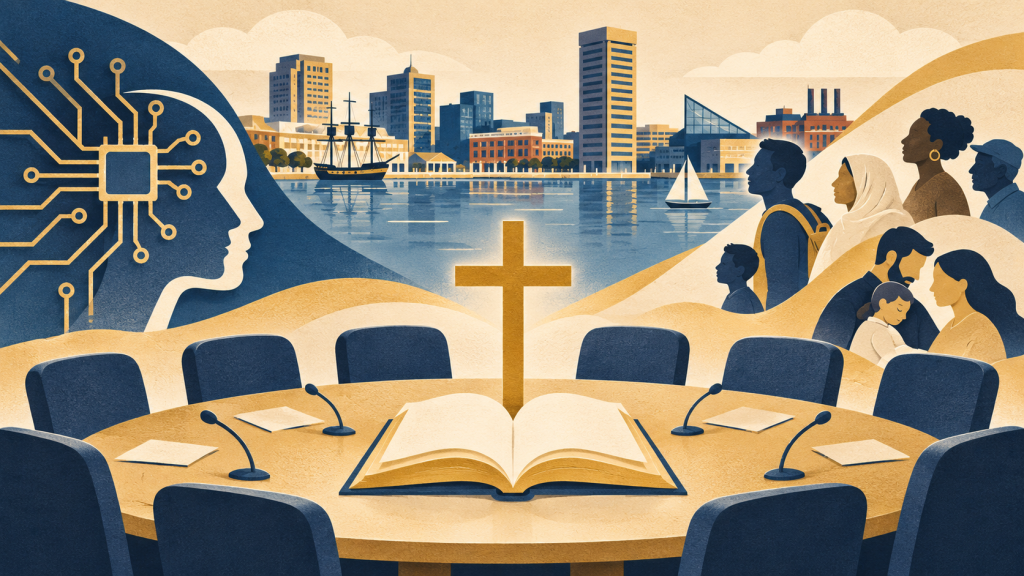
Original AI-generated editorial illustration for CatholicPaper; not a photograph of a USCCB assembly.
In this article
U.S. Catholic bishops will gather in Baltimore, Maryland, November 16–19 for their fall plenary assembly, with artificial intelligence, immigration, and signs of renewed interest in the Church among the expected subjects.
The USCCB November 2026 meeting will include public sessions on November 17–18, allowing Catholics to follow the proceedings online. As of November 14, the gathering remains ahead: scheduled presentations and proposed votes should not be read as decisions already taken.
The USCCB’s October 20 announcement and its November preview outline the expected business. The conference cautions that the preliminary agenda can change; the bishops will approve the final agenda when they convene.
Artificial Intelligence and the Dignity of the Human Person
An update is expected from the Task Force on Preserving Human Dignity in the Age of Artificial Intelligence. Bishop Oscar Cantú of San Jose, California, chairs the group, which the bishops’ Administrative Committee established in September after conversations with technology companies and specialists.
The announcement establishing the task force identifies concerns extending beyond technical performance: protection of workers, families, religious liberty, democratic institutions, and vulnerable people. It also emphasizes human oversight, safeguards against misuse, and benefits accessible to people across economic circumstances.
For ordinary Catholics, those concerns connect with tools already entering classrooms, workplaces, and family life. Questions about whether technology serves people, who bears its risks, and how children are protected are moral questions as well as technical ones. These are implications of the task force’s stated mission, rather than a prediction of specific policies the assembly will adopt.
The task-force report is an update, not an announced vote on a comprehensive AI teaching document. Separately, proposed revisions to the conference’s investment guidelines address emerging issues including AI, according to the November preview.
Immigration Update and Catholic Social Teaching
The October announcement schedules a report from the chairman of the Committee on Migration, one year after the bishops adopted their special message on immigration. OSV News’s reporting on the agenda places that update against continuing controversy over immigration enforcement and the bishops’ opposition to indiscriminate mass deportation.
The Church’s position cannot be reduced to either unrestricted borders or indifference to migrants. The USCCB’s explanation of Catholic social teaching on migration holds together a person’s right to seek the necessities of life, a country’s right to regulate immigration, and the requirement that regulation serve justice, mercy, and the common good.
That framework also gives weight to family unity and basic human dignity regardless of legal status. It helps explain why immigration is a pastoral concern for parishes and Catholic institutions, not simply a matter of electoral debate. An update in Baltimore should not be described in advance as a newly adopted immigration statement.
Signs of Renewal Require Careful Reading
The bishops are expected to consider reports of growing numbers entering the Church and renewed religious interest among young people. The newer USCCB preview includes a workshop focused on a new generation of seekers, while the October release describes a panel on signs of new life.
Such reports can identify meaningful developments in particular communities without establishing a nationwide reversal of religious disaffiliation. OSV News notes disagreement among researchers about the evidence, including concerns about some survey methods. A larger initiation group in one parish and a change in the country’s Catholic population are different measurements.
Earlier national evidence supplies an important caution. Reporting on Pew Research Center’s 2023–24 Religious Landscape Study, OSV News described substantial net losses through religious switching and a persistent age gap in religious involvement. That study predates this year’s reported developments and cannot, by itself, settle what is happening in 2026.
The practical question for parishioners is how to welcome people who are asking about the faith while continuing to accompany those who have drifted away. CatholicPaper’s recent coverage of Pope Leo XIV’s encouragement to families passing on the faith explores that pastoral responsibility.
Liturgical Texts, Sainthood Consultations, and Administration
Expected action items include a new edition of the Lectionary for Mass and Book of the Gospels. These books concern Scripture proclaimed in worship; readers unfamiliar with their place in the liturgy can consult CatholicPaper’s guide to the Catholic Mass. A proposed vote is not notice that parishes should begin using new books immediately.
The bishops are also expected to undertake canonical consultations concerning proposed beatification and canonization causes for Maria Middleton and Thomas Steven Vander Woude. Such consultation is a step concerning possible causes, not a declaration that either person has been beatified or canonized.
Other anticipated votes concern diocesan financial reporting, socially responsible investments, and the 2027 conference budget. Also listed are a proposed annual Day of Prayer for Racial Justice and work toward updating the pastoral plan for pro-life activities. These proposals connect national administration with worship, stewardship, and pastoral priorities, but their outcomes remain to be determined.
Leadership Elections
According to the USCCB’s election announcement, the bishops will choose a conference secretary and chairmen for six committees: Catholic Education, Communications, Cultural Diversity in the Church, Doctrine, National Collections, and Pro-Life Activities.
The committee chairs will first serve a year as chairmen-elect, then begin three-year terms after the fall 2027 assembly. A new general secretary is also to be elected. The public proceedings are expected to open with addresses from conference president Archbishop Paul S. Coakley and the apostolic nuncio, Archbishop Gabriele Caccia.
How to Watch the Public Sessions
Catholics can watch the November 17–18 public sessions through usccb.org/meetings. Check the conference’s November assembly page for finalized information and materials as they become available. Public livestream dates cover only part of the November 16–19 gathering.
Following the actual presentations and vote results will help readers distinguish discussion from policy and proposals from approved action. For Catholics in the pews, the meeting offers a view of how their bishops approach human dignity, evangelization, public life, and the practical responsibilities of serving the Church.