Prayer to St. Michael the Archangel: Full Text, Meaning & How to Pray It
The Prayer to St. Michael the Archangel is one of the most beloved prayers in Catholic tradition. For generations, Catholics have turned to St. Michael for protection against evil, strength during temptation, and courage in their daily spiritual struggles.
With its powerful opening words, “St. Michael the Archangel, defend us in battle,” the prayer reminds us that the Christian life involves more than the challenges we can see. Scripture teaches that spiritual realities exist beyond the material world and that God’s grace strengthens us in our struggle against sin and evil.
Yet the Prayer to St. Michael is not simply about spiritual warfare. At its heart, it is a prayer of trust in God’s power, a request for heavenly assistance, and a reminder that evil does not have the final word.
Whether you learned this prayer as a child, heard it recited after Mass, or are discovering it for the first time, understanding its words can help you pray with greater confidence and devotion.
In this guide, we’ll explore the full Prayer to St. Michael the Archangel, its meaning, its history, the biblical foundations of devotion to St. Michael, and practical ways to incorporate this traditional Catholic prayer into everyday life.
Prayer to St. Michael the Archangel — Full Traditional Text
The traditional English version of the prayer reads:
St. Michael the Archangel,
defend us in battle.
Be our protection against the wickedness
and snares of the devil.
May God rebuke him, we humbly pray;
and do thou, O Prince of the heavenly host,
by the power of God,
cast into hell Satan and all the evil spirits
who prowl about the world
seeking the ruin of souls.
Amen.
This is the familiar short form of the Prayer to St. Michael, traditionally associated with Pope Leo XIII.
The prayer asks St. Michael to intercede for us and defend us against evil through the power of God. Its words emphasize that victory over evil belongs ultimately to God, not to any creature acting independently of Him.
Catholics may pray it privately, with their families, or in parish communities. In some parishes, it is also recited after Mass as a devotional practice.
Who Is St. Michael the Archangel?
St. Michael is one of the angels named in Sacred Scripture and is recognized by the Catholic Church as an archangel.
His name comes from the Hebrew Mikha’el, commonly understood to mean “Who is like God?”
This name is itself a declaration of faith. It emphasizes that no creature, whether human or angelic, can equal the majesty and authority of God.
St. Michael is traditionally associated with defending God’s people, opposing Satan, and serving the divine will.
Unlike human saints, who lived earthly lives and entered heavenly glory, St. Michael is an angel: a spiritual creature created by God.
Catholic teaching describes angels as personal, spiritual beings possessing intelligence and will. They serve God and participate in His providential care for creation.
The Church honors St. Michael not as a rival to Christ or as an independent source of supernatural power, but as a faithful servant of God.
Why Is Michael Called an Archangel?
The title archangel identifies Michael with an important angelic role.
In the New Testament, Michael is explicitly called “the archangel” in Jude 1:9.
The Catholic tradition also recognizes Gabriel and Raphael among the three archangels named in the Church’s liturgical tradition.
Michael is especially associated with spiritual defense, Gabriel with the announcement of God’s message, and Raphael with healing and guidance.
Their missions differ, but each points beyond himself toward God’s goodness and providence.
Suggested Scripture: Jude 1:9; Daniel 12:1
What Does the Prayer to St. Michael Mean? A Line-by-Line Explanation
The Prayer to St. Michael is short, but its language carries considerable theological meaning.
Understanding each phrase helps prevent the prayer from becoming merely a formula repeated without reflection.
“St. Michael the Archangel, defend us in battle”
The opening words ask St. Michael for assistance in spiritual conflict.
This battle should not be understood as a call to violence against other people.
Rather, Catholic spirituality recognizes a struggle against temptation, sin, deception, and the influence of evil.
Every Christian experiences moments when choosing what is right requires courage.
We may struggle with pride, dishonesty, resentment, selfishness, or despair.
By asking St. Michael to defend us, we seek the assistance of a heavenly servant who remains faithful to God.
The prayer reminds us that spiritual strength is not simply a matter of personal determination. We depend on God’s grace.
“Be our protection against the wickedness and snares of the devil”
The word snares refers to traps or deceptive strategies.
Catholic teaching holds that Satan is a fallen angel who opposes God and seeks to lead human beings away from Him.
However, the Church does not teach that Satan is equal to God.
The devil is a created being whose power is limited and subject to divine providence.
This distinction is important.
Catholics should neither dismiss the reality of spiritual evil nor become excessively fearful or preoccupied with it.
The Christian response is to remain rooted in faith, prayer, the sacraments, and trust in Jesus Christ.
The request for protection is therefore an expression of confidence in God rather than fear of an uncontrollable evil power.
“May God rebuke him, we humbly pray”
This line places God’s authority at the center of the prayer.
We are not asking St. Michael to defeat evil through power that exists independently of God.
Instead, we ask God to restrain the devil.
The phrase also reflects humility.
Human beings cannot overcome every spiritual difficulty through their own strength.
We need divine grace, wisdom, and protection.
The wording recalls the biblical theme of evil being confronted under God’s authority.
Suggested Scripture: Jude 1:9
“And do thou, O Prince of the heavenly host”
The phrase heavenly host refers to the armies or multitudes of heaven.
Calling St. Michael the prince of the heavenly host reflects his traditional association with leadership among the angels in their opposition to Satan.
The imagery is particularly connected with the Book of Revelation, which describes Michael and his angels fighting against the dragon.
The image of heavenly conflict is not intended to suggest that heaven is governed by competing powers of equal strength.
Rather, it expresses the triumph of God’s purposes over rebellion and evil.
“By the power of God”
These words are among the most important in the entire prayer.
They make clear that St. Michael acts only through God’s power.
In Catholic belief, angels are creatures, not gods.
They cannot replace Jesus Christ, whose death and Resurrection are the decisive victory over sin and death.
The prayer therefore remains fundamentally God-centered.
St. Michael’s assistance is understood as part of God’s providential care for His people.
“Cast into hell Satan and all the evil spirits”
This phrase reflects the traditional Christian understanding of the final defeat of Satan and the powers of evil.
It uses strong biblical imagery to express a longing for God’s justice and the complete overcoming of evil.
The words are not an invitation for ordinary Catholics to conduct exorcisms or attempt to command evil spirits.
Rather, the prayer entrusts the struggle against evil to God’s authority.
In Catholic practice, solemn exorcism is a distinct ministry reserved to a priest who has received specific authorization from the local bishop.
Ordinary devotional prayer, including the Prayer to St. Michael, should be understood within its proper spiritual context.
“Who prowl about the world seeking the ruin of souls”
The final phrase expresses the seriousness of temptation and spiritual deception.
The New Testament warns Christians to remain watchful against the devil’s efforts to draw people away from faithfulness to God.
Yet the Christian message is not one of hopelessness.
Scripture also teaches that believers can resist temptation, remain steadfast in faith, and trust in God’s sustaining grace.
The prayer ends with confidence that divine assistance is available.
Suggested Scripture: 1 Peter 5:8–10; James 4:7–8
The Biblical Foundations of St. Michael the Archangel
Although the traditional Prayer to St. Michael was composed long after the biblical period, devotion to the archangel is rooted in Scripture.
Several passages help explain his significance in Catholic tradition.
Revelation 12:7–9 — Michael and the Dragon
One of the best-known passages concerning St. Michael appears in the Book of Revelation.
The text describes a conflict in heaven between Michael and his angels and the dragon, identified with Satan.
The dragon and his angels are defeated and cast down.
This dramatic vision has profoundly influenced Christian art, prayer, and devotion.
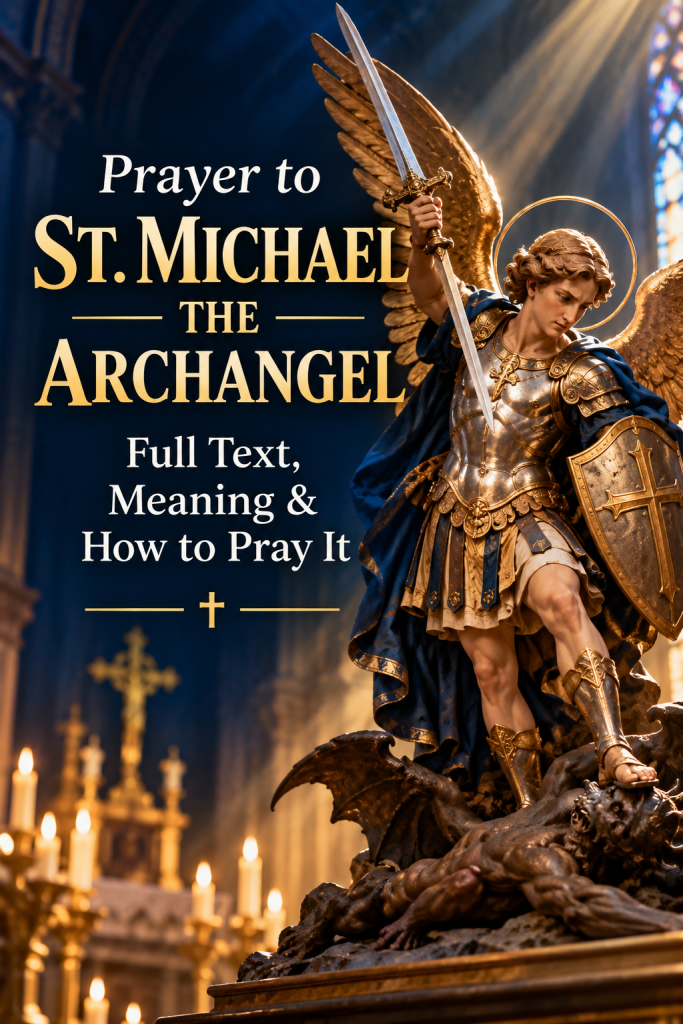
St. Michael is frequently depicted wearing armor, holding a sword or spear, and standing over a dragon.
These images symbolize the victory of God’s authority over evil.
They should be understood within the symbolic and theological language of apocalyptic Scripture.
Suggested Scripture: Revelation 12:7–12
Daniel 10 — Michael as a Heavenly Prince
The Book of Daniel refers to Michael as one of the chief princes.
He appears in the context of heavenly conflict and the protection of God’s people.
These passages contribute to the traditional understanding of Michael as a defender.
They also remind readers that biblical descriptions of angels often appear in visions and prophetic literature, where symbolic language is especially important.
Suggested Scripture: Daniel 10:13–21
Daniel 12:1 — Protector of God’s People
Daniel 12:1 describes Michael as the great prince who stands over the people of God.
The passage connects his role with a time of distress and God’s ultimate deliverance.
For Catholics, this reinforces the association between St. Michael and protection in times of spiritual difficulty.
Suggested Scripture: Daniel 12:1–3
Jude 1:9 — Michael the Archangel
The Letter of Jude contains a reference to Michael disputing with the devil.
Rather than pronouncing judgment through his own authority, Michael appeals to the Lord.
This passage closely reflects the wording of the Prayer to St. Michael:
“May God rebuke him.”
It reinforces the Catholic understanding that the authority of angels is always subordinate to God’s authority.
Suggested Scripture: Jude 1:9
The History of the Prayer to St. Michael
The familiar short Prayer to St. Michael is traditionally associated with Pope Leo XIII, who served as pope from 1878 to 1903.
During his pontificate, the Church promoted a set of prayers recited after Low Mass, commonly known as the Leonine Prayers.
In 1886, the Prayer to St. Michael was added to these prayers.
For many decades, Catholics became accustomed to hearing it after Mass.
This widespread practice helped establish the prayer as one of the most recognizable devotions in Catholic life.
Did Pope Leo XIII Have a Vision?
A popular story claims that Pope Leo XIII experienced a disturbing vision or supernatural encounter that inspired him to compose the prayer.
Different versions of this account describe a confrontation involving Satan and the Church.
However, the details of the alleged vision are not firmly established by reliable contemporary documentation.
For that reason, Catholics should distinguish between the documented history of the prayer’s adoption and later devotional stories about its origin.
The prayer’s spiritual value does not depend on proving the details of a particular vision.
Its central themes—trust in God, resistance to evil, and the intercession of St. Michael—are firmly connected to Catholic teaching and biblical tradition.
Why Did Catholics Stop Reciting It After Every Mass?
The Leonine Prayers were no longer required after Mass following liturgical reforms in the 1960s.
This change did not prohibit Catholics from praying to St. Michael.
The prayer remains a legitimate Catholic devotion.
Today, some parishes recite it after the dismissal at Mass, while others encourage its use in personal or family prayer.
Its continued popularity demonstrates the lasting place of devotion to St. Michael in Catholic spirituality.
When Should Catholics Pray the Prayer to St. Michael?
There is no single required time to pray to St. Michael.
Because it is a devotional prayer, Catholics can incorporate it into their spiritual lives in several ways.
After Mass
Some Catholic communities recite the Prayer to St. Michael after Mass.
This can be a meaningful way to ask for spiritual strength as worshippers return to their daily responsibilities.
Participation in the prayer is a devotional practice rather than a universal requirement of the Mass.
During Morning Prayer
Praying to St. Michael at the beginning of the day can help establish a spirit of vigilance and trust.
Before facing work, family responsibilities, difficult conversations, or personal challenges, Catholics may ask for the grace to resist temptation and act with charity.
During Evening Prayer
The prayer can also be incorporated into an evening examination of conscience.
After reflecting on the day, a person might pray the Act of Contrition and then ask St. Michael’s intercession for continued spiritual strength.
During Times of Temptation
When struggling with temptation, Catholics may turn to God through brief prayers, Scripture, and the intercession of the saints and angels.
The Prayer to St. Michael can help direct attention away from fear and toward trust in God’s grace.
With Family Members
Families may pray together before leaving for school or work, after the Rosary, or during regular family devotions.
For children, the prayer can be introduced with a simple explanation that God sends His angels to serve His purposes and that Christians should always trust in God’s loving care.
Can Catholics Pray to St. Michael Instead of God?
This is an important question, especially for people unfamiliar with Catholic devotion to angels and saints.
Catholics worship God alone.
The Church distinguishes between the worship owed exclusively to God and the honor given to saints and angels.
When Catholics pray to St. Michael, they are asking for his intercession and assistance as a servant of God.
They are not treating him as a deity or as an alternative to Jesus Christ.
The traditional prayer itself makes this distinction clear by saying that St. Michael acts “by the power of God.”
Jesus Christ remains the one mediator between God and humanity in the fullest and unique sense.
The intercession of angels and saints is understood as entirely dependent upon Christ and His saving work.
Devotion to St. Michael should therefore strengthen a Catholic’s relationship with God rather than distract from it.
What Does the Catholic Church Teach About Angels?
The existence of angels is part of Catholic doctrine.
The Catechism of the Catholic Church teaches that angels are spiritual, personal, and immortal creatures who possess intelligence and will.
They are servants and messengers of God.
Throughout Sacred Scripture, angels appear in connection with divine messages, protection, worship, and the unfolding of salvation history.
The angel Gabriel announces the birth of Jesus to Mary.
Angels minister to Jesus in the Gospels.
And the Book of Revelation describes heavenly worship and the struggle against evil.
Catholic teaching does not encourage believers to become obsessed with identifying angels, assigning them hidden powers, or seeking secret knowledge about the spiritual world.
Instead, the Church directs attention toward God’s providence and the saving work of Jesus Christ.
The angels are important precisely because they serve God’s purposes.
Suggested Scripture: Luke 1:26–38; Hebrews 1:14
St. Michael and Spiritual Warfare: What Catholics Should Understand
The phrase spiritual warfare can sound dramatic or frightening.
However, in Catholic spirituality, it primarily concerns the ongoing struggle to remain faithful to God amid temptation, sin, and evil.
The Letter to the Ephesians describes the Christian struggle in spiritual terms and encourages believers to put on the armor of God.
This imagery calls Christians to truth, righteousness, faith, prayer, and perseverance.
It is not a command to treat other human beings as enemies.
Spiritual Warfare Begins With Everyday Choices
Many spiritual struggles occur in ordinary situations.
Choosing honesty when dishonesty would be easier.
Forgiving someone when resentment feels more satisfying.
Resisting gossip.
Showing patience toward a difficult person.
Remaining faithful to prayer when distracted or discouraged.
These choices may seem small, but they shape a person’s spiritual life.
The Prayer to St. Michael reminds Catholics that faithfulness requires both vigilance and grace.
Prayer Is Not a Substitute for the Sacraments
The Church offers many forms of spiritual support, including personal prayer, the Eucharist, and the Sacrament of Reconciliation.
Devotion to St. Michael should complement these central practices.
It should not replace attendance at Mass, sacramental Confession when needed, or the ordinary responsibilities of Christian discipleship.
Avoid Fear and Superstition
Catholics should avoid treating the Prayer to St. Michael as a magical formula.
Its effectiveness is not based on reciting certain words a specific number of times or performing secret rituals.
Christian prayer is an act of faith and trust in God.
The Church also encourages prudence in interpreting unusual experiences.
Not every hardship, illness, emotional struggle, or difficult circumstance should be attributed to demonic activity.
The Christian response is to remain grounded in faith, reason, charity, and appropriate spiritual guidance.
Suggested Scripture: Ephesians 6:10–18
How to Make the Prayer to St. Michael Part of Your Daily Life
One of the best ways to develop a meaningful devotion is to connect prayer with an existing daily habit.
For example, you might pray the Prayer to St. Michael immediately after your morning prayers.
Begin with the Sign of the Cross.
Thank God for the gift of a new day.
Ask for wisdom and strength to live according to His will.
Then recite the Prayer to St. Michael slowly, reflecting on its central request for protection against evil.
Conclude by asking God to help you recognize opportunities for kindness, honesty, patience, and courage.
The entire practice can take only a few minutes.
You might also combine the prayer with other traditional Catholic devotions, such as the Our Father, Hail Mary, Glory Be, or Rosary.
The goal is not to accumulate as many prayers as possible.
It is to develop a consistent relationship with God and become more attentive to His presence in daily life.
The Feast of St. Michael and the Archangels
The Catholic Church celebrates the Feast of Saints Michael, Gabriel, and Raphael, Archangels, on September 29.
The feast honors these three named archangels and their service in God’s plan of salvation.
St. Michael is traditionally associated with defense against evil.
St. Gabriel is known for announcing God’s message, especially the Annunciation to the Virgin Mary.
St. Raphael appears in the Book of Tobit as a guide and instrument of God’s healing.
The feast offers Catholics an opportunity to reflect on the ministry of angels and the ways God cares for His people.
It is also a fitting occasion to pray the Prayer to St. Michael and read the biblical passages associated with the archangels.
Suggested Scripture: Revelation 12:7–12; Luke 1:26–38; Tobit 12:6–15
Frequently Asked Questions About the Prayer to St. Michael
What Is the Prayer to St. Michael Used For?
Catholics pray it to ask for protection against evil, assistance in resisting temptation, and spiritual strength through the intercession of St. Michael.
Its central focus is trust in God’s authority and power.
Is the Prayer to St. Michael an Official Catholic Prayer?
Yes. It is a longstanding Catholic devotional prayer historically associated with Pope Leo XIII and the Leonine Prayers.
It is not a required part of every celebration of Mass.
Who Wrote the Prayer to St. Michael?
The familiar short prayer is traditionally attributed to Pope Leo XIII and was added to the prayers after Low Mass in 1886.
Stories about a particular vision inspiring the prayer should be treated with historical caution.
Is St. Michael Mentioned in the Bible?
Yes. Michael appears in the Book of Daniel, the Letter of Jude, and the Book of Revelation.
These passages form the biblical foundation for his traditional association with spiritual defense.
Can I Pray the Prayer to St. Michael Every Day?
Yes. Catholics may pray it daily as part of their personal or family devotions.
There is no requirement to limit it to a particular day or occasion.
Should Catholics Be Afraid of the Devil?
Catholic teaching recognizes the reality of Satan and evil, but Christians are called to trust in the victory of Jesus Christ.
The Prayer to St. Michael should inspire confidence in God’s protection rather than excessive fear.
Is St. Michael a Patron Saint?
Yes. St. Michael is traditionally honored as a patron of various groups, including police officers, military personnel, and others whose work involves protection or public service.
Can Children Learn the Prayer to St. Michael?
Yes. Children can learn the prayer with age-appropriate explanations.
Parents may emphasize God’s love, the importance of making good choices, and the belief that angels serve God.
Is the Prayer to St. Michael an Exorcism?
The familiar short prayer is a devotional prayer for protection, not the Church’s rite of solemn exorcism.
Catholics should not confuse ordinary prayers for spiritual protection with the specialized ministry of exorcism.
A Final Reflection: St. Michael Points Us Toward God
The Prayer to St. Michael the Archangel has remained meaningful to Catholics because it speaks to a universal human experience: the struggle to choose good in a world where evil and temptation exist.
Its language is dramatic, but its central message is simple.
God is greater than evil.
We are not called to face every spiritual challenge through our own strength.
And the Christian life is sustained by divine grace.
St. Michael’s very name—“Who is like God?”—reminds us that no created power can compare with the Lord.
When Catholics ask for St. Michael’s intercession, they are ultimately expressing confidence in the God whom the archangel serves.
The prayer invites us to remain watchful without becoming fearful, courageous without becoming proud, and faithful without relying solely on ourselves.
Whether recited after Mass, during morning prayer, or in a moment of temptation, the Prayer to St. Michael can become a daily reminder to turn toward Christ.
May our devotion to St. Michael strengthen our trust in God, deepen our commitment to goodness, and remind us that the victory over sin and evil belongs to Jesus Christ.
Continue Exploring Catholic Prayer
The Prayer to St. Michael is one of many traditional Catholic prayers that can strengthen daily faith.
Explore these related topics to continue growing in prayer and spiritual understanding:
- The Our Father: Discover the meaning of the prayer Jesus taught His disciples.
- The Hail Mary: Learn the biblical foundations and meaning of this beloved Marian prayer.
- The Glory Be: Explore a short but profound prayer honoring the Holy Trinity.
- The Act of Contrition: Understand repentance, forgiveness, and the Catholic practice of Confession.
- How to Pray the Rosary: Follow a complete beginner’s guide to praying and meditating on the mysteries of the Rosary.
- How to Build a Daily Catholic Prayer Routine: Learn practical ways to make prayer a consistent part of everyday life.