
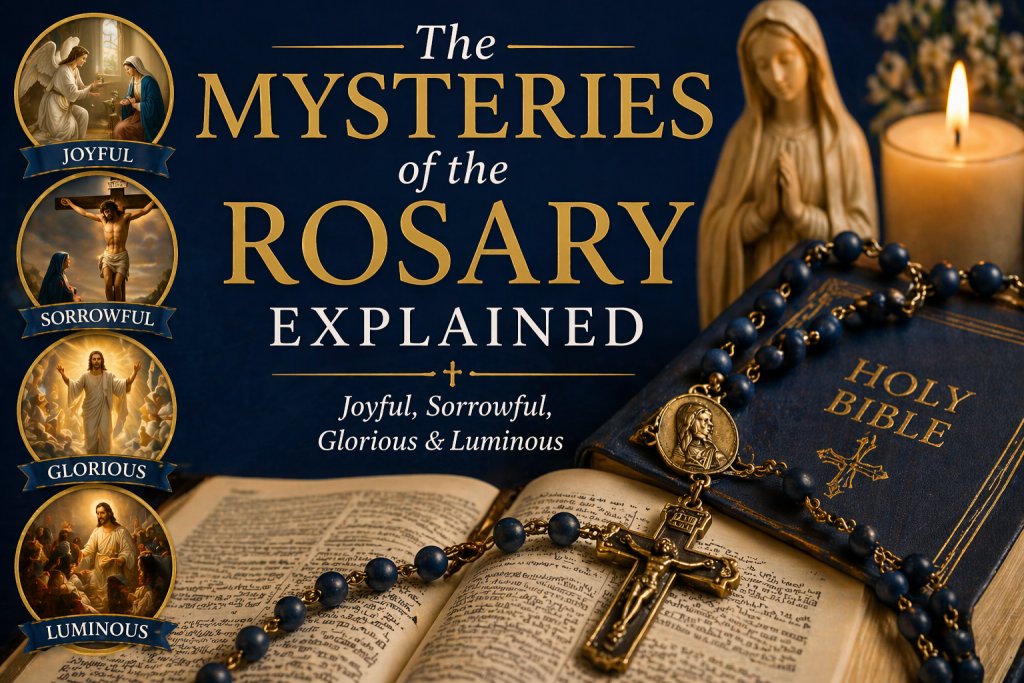
The Mysteries of the Rosary Explained (Joyful, Sorrowful, Glorious & Luminous)
Introduction
The mysteries of the rosary explained in this guide will help you deepen your prayer and meditation on the life of Christ. The Rosary is one of the most beloved and widely practiced devotions in the Catholic Church. For centuries, Catholics around the world have turned to this prayer to deepen their relationship with Christ, seek the intercession of the Blessed Virgin Mary, and meditate on the central mysteries of the Christian faith.
At first glance, the Rosary may appear to be simply a repetition of familiar prayers such as the Our Father, the Hail Mary, and the Glory Be. Yet the Rosary is much more than a sequence of prayers. At its heart, it is a form of meditation that invites the faithful to reflect on key moments in the life of Jesus Christ and His mother Mary. These moments are known as the Mysteries of the Rosary, and they guide the believer through the story of salvation.
The mysteries help transform the Rosary into a contemplative journey. As each decade is prayed, the mind and heart are directed toward an event from the Gospel. In this way, the Rosary becomes a prayer rooted deeply in Scripture and in the Church’s understanding of Christ’s life, suffering, death, and resurrection.
In this guide, we will explore each set of mysteries—the Joyful, Sorrowful, Glorious, and Luminous Mysteries—and explain their meaning, biblical foundation, and spiritual significance. By understanding these mysteries more deeply, Catholics can enrich their prayer life and encounter the Gospel in a more personal and transformative way.
What Are the Mysteries of the Rosary?
In everyday language, the word “mystery” often refers to something hidden or difficult to understand. In Catholic spirituality, however, a mystery refers to a sacred truth of faith that reveals God’s plan of salvation. The mysteries of the Rosary highlight important moments in the life of Jesus Christ and invite believers to meditate on them through prayer.
Each decade of the Rosary corresponds to one mystery. While praying ten Hail Marys, the believer reflects on the spiritual meaning of that event. This combination of vocal prayer and meditation allows the Rosary to engage both the heart and the mind.
The mysteries are divided into four groups:
- The Joyful Mysteries
- The Sorrowful Mysteries
- The Glorious Mysteries
- The Luminous Mysteries
Together they trace the entire story of Christ’s life—from His conception and birth to His suffering, resurrection, and glory.
The Rosary is therefore not simply a Marian devotion; it is a profoundly Christ-centered prayer. Through Mary’s perspective, believers contemplate the life and mission of Jesus. St. John Paul II described the Rosary as a prayer that “leads to the heart of the Gospel.”
The Joyful Mysteries
The Joyful Mysteries focus on the early events in the life of Jesus and highlight the joy that accompanies the coming of the Savior. They reveal God’s humility in entering human history through the family of Mary and Joseph.
The Annunciation
The first Joyful Mystery is the Annunciation, when the Angel Gabriel appeared to Mary and announced that she would conceive and bear the Son of God.
Mary’s response, “Let it be done to me according to your word,” represents one of the most profound acts of faith in human history. Her “yes” to God opened the way for the Incarnation.
This mystery reminds Catholics that God’s plans often begin quietly and unexpectedly. It also invites believers to imitate Mary’s trust and obedience when God calls them to something new.
Scripture: Luke 1:26–38
The Visitation
The second Joyful Mystery recounts Mary’s visit to her cousin Elizabeth. Upon hearing Mary’s greeting, the child in Elizabeth’s womb—John the Baptist—leapt for joy.
Elizabeth proclaimed Mary blessed among women, recognizing the presence of the Lord even before His birth.
The Visitation shows how Christ brings joy and transformation to others through those who carry Him. Catholics are reminded that their own faith can become a source of encouragement and hope for those around them.
Scripture: Luke 1:39–56
The Nativity
The Nativity celebrates the birth of Jesus in Bethlehem. Despite being the King of Kings, Christ entered the world in poverty and humility, laid in a manger.
This mystery reveals the profound humility of God. It teaches believers that true greatness is found not in power or wealth but in love, sacrifice, and simplicity.
The Nativity also reminds Catholics that God draws close to humanity, sharing in human life and experience.
Scripture: Luke 2:1–20
The Presentation in the Temple
In the fourth Joyful Mystery, Mary and Joseph present the infant Jesus in the Temple according to Jewish law.
During this moment, the righteous man Simeon recognizes Jesus as the promised Messiah and foretells that Mary’s heart will one day be pierced with sorrow.
The Presentation foreshadows the suffering that Christ will endure for humanity’s redemption.
Scripture: Luke 2:22–38
The Finding of Jesus in the Temple
The final Joyful Mystery describes the moment when Mary and Joseph find the twelve-year-old Jesus teaching in the Temple after searching for Him for three days.
Jesus’ words—“Did you not know that I must be about my Father’s business?”—reveal His growing awareness of His divine mission.
This mystery invites believers to seek Christ diligently and to place God’s will at the center of their lives.
Scripture: Luke 2:41–52
The Sorrowful Mysteries
The Sorrowful Mysteries focus on Christ’s suffering and death. They remind Catholics of the depth of God’s love and the price of humanity’s redemption.
The Agony in the Garden
On the night before His crucifixion, Jesus prayed in the Garden of Gethsemane. Overwhelmed with sorrow, He asked the Father if the cup of suffering could pass from Him—but ultimately surrendered to God’s will.
This mystery teaches the power of prayer in times of fear and uncertainty.
Scripture: Matthew 26:36–46
The Scourging at the Pillar
Jesus was brutally scourged by Roman soldiers. This suffering fulfills the prophecy that the Messiah would bear the wounds of humanity’s sins.
Meditating on this mystery helps Catholics reflect on the seriousness of sin and the immeasurable love Christ showed through His sacrifice.
The Crowning with Thorns
Roman soldiers mocked Jesus by placing a crown of thorns on His head and calling Him “King of the Jews.”
This mystery reveals the contrast between earthly power and Christ’s humble kingship.
The Carrying of the Cross
Jesus carried His cross to Calvary, assisted by Simon of Cyrene. Along the way He encountered the suffering of others, including His mother Mary.
This mystery reminds believers that following Christ often involves carrying personal crosses with faith and perseverance.
The Crucifixion
The final Sorrowful Mystery is the crucifixion and death of Jesus on the cross.
Here Christ offers Himself completely for the salvation of the world. His final words—“Father, forgive them”—reveal the depth of divine mercy.
This mystery stands at the center of Christian faith: through the cross, death is transformed into the path to new life.
Scripture: Luke 23:33–46
The Glorious Mysteries
The Glorious Mysteries celebrate Christ’s victory over sin and death and the hope of eternal life.
The Resurrection
On the third day after His crucifixion, Jesus rose from the dead. The Resurrection is the cornerstone of the Christian faith and the ultimate sign of God’s triumph over death.
For Catholics, this mystery offers hope that suffering and death do not have the final word.
Scripture: Matthew 28:1–10
The Ascension
Forty days after the Resurrection, Jesus ascended into heaven.
The Ascension marks the completion of Christ’s earthly mission and the beginning of the Church’s mission to proclaim the Gospel to all nations.
Scripture: Acts 1:6–11
The Descent of the Holy Spirit
At Pentecost, the Holy Spirit descended upon the apostles, empowering them to spread the Gospel with courage and conviction.
This event marks the birth of the Church and reminds believers that they too receive the Spirit’s guidance.
Scripture: Acts 2:1–4
The Assumption of Mary
Catholics believe that at the end of her earthly life, Mary was assumed body and soul into heaven.
The Assumption reveals the destiny that awaits those who remain faithful to God.
The Coronation of Mary
The final Glorious Mystery reflects the Church’s belief that Mary reigns as Queen of Heaven.
This mystery celebrates the honor given to Mary for her faithful cooperation with God’s plan of salvation.
The Luminous Mysteries
In 2002, Pope St. John Paul II introduced the Luminous Mysteries to highlight important moments in Christ’s public ministry.
The Baptism of Jesus
Jesus’ baptism in the Jordan River marks the beginning of His public mission. The voice of the Father declares Him the beloved Son.
The Wedding at Cana
At the wedding feast in Cana, Jesus performs His first public miracle by turning water into wine.
This mystery reveals Mary’s intercession and Christ’s power to transform ordinary situations.
The Proclamation of the Kingdom
Jesus traveled throughout Israel preaching repentance and announcing the coming of God’s kingdom.
The Transfiguration
On Mount Tabor, Jesus was transfigured before Peter, James, and John, revealing His divine glory.
The Institution of the Eucharist
At the Last Supper, Jesus instituted the Eucharist, giving His Body and Blood as spiritual nourishment for believers.
How to Meditate on the Mysteries
Praying the Rosary becomes more meaningful when believers intentionally reflect on each mystery.
Some helpful ways to meditate include:
- Reading the related Scripture passage before praying the decade
- Visualizing the Gospel scene
- Asking how the mystery applies to your own life
Our Father Prayer, Hail Mary Prayer, Glory Be Prayer
Why the Rosary Remains One of the Church’s Most Powerful Prayers
Throughout history, many saints—including St. Dominic, St. Padre Pio, and St. John Paul II—have strongly promoted the Rosary.
They believed the Rosary helps believers:
- Grow closer to Christ
- Reflect on the Gospel
- Develop discipline in prayer
- Experience Mary’s intercession
Because it combines Scripture, meditation, and prayer, the Rosary remains one of the most accessible and spiritually rich devotions in Catholic life.
Conclusion
The mysteries of the rosary explained in this guide will help you deepen your prayer and meditation on the life of Jesus Christ—from His birth to His resurrection and glory. By meditating on these mysteries, believers encounter the Gospel in a deeply personal way.
Whether prayed individually or with others, the Rosary continues to be a powerful path to spiritual growth. Through Mary’s guidance, Catholics are invited to contemplate the life of Christ and draw closer to Him with every prayer.